


How to Choose Water Truck Capacity for Your Project
Views: 0 Author: Site Editor Publish Time: 2026-11-23 Origin: Site


Choosing the right water truck capacity depends on your project's daily water demand, site size, refill distance, and operating conditions. Smaller tanks are often suitable for urban construction, landscaping, and projects with nearby water sources, while larger-capacity water trucks can reduce refill trips on extensive construction sites and mining operations. However, tank volume must also match the truck's payload capacity, pump performance, terrain conditions, and legal weight limits. For contractors and fleet operators, balancing these factors helps maintain efficient water delivery while avoiding unnecessary operating costs and equipment limitations.
An effective capacity decision also requires evaluating the complete water filling, transport, and discharge cycle. It requires optimizing the entire refill-to-discharge cycle. A massive tank on a small site creates mobility issues, while a small tank on a massive site creates costly refill delays. This guide provides a systematic framework for evaluating equipment based on project scope, terrain realities, and regulatory compliance. You will learn how to match tank size to site demands and ensure maximum return on your equipment investment.
Key Takeaways
Water truck capacity must be calculated by balancing daily application requirements against the distance to the nearest water source (cycle time).
Standard on-highway trucks typically max out around 4,000 to 5,000 gallons due to Gross Vehicle Weight Rating (GVWR) and bridge laws, while off-road articulated trucks can exceed 10,000 gallons.
Over-sizing a tank introduces severe risks, including dangerous shifts in the center of gravity, increased braking distances, and excessive soil compaction.
Regulatory compliance—specifically Commercial Driver’s License (CDL) requirements and tanker endorsements—scales strictly with the chosen capacity and vehicle weight.
Tank shape (elliptical vs. rectangular) and material thickness are just as critical as raw volume when determining vehicle stability and equipment longevity.
Table of Contents
How Water Truck Capacity Affects Project Efficiency
The Hidden Costs of Under-Sizing
Every unnecessary trip to the standpipe burns fuel and wages. If a tank is too small, the truck spends more time in transit than spraying. This leaves graders and rollers idling on the fill. When heavy machinery sits idle waiting for moisture conditioning, your hourly operational costs skyrocket without any corresponding progress in yardage moved. Inadequate water volume leads to inconsistent dust suppression across the site, which can trigger regulatory fines or shut down operations entirely if wind conditions worsen.
Under-sizing also causes suboptimal soil moisture content during earthmoving operations. Achieving optimum moisture content is a strict engineering requirement for structural fill. If your truck cannot deliver enough water to penetrate the soil lifts adequately, the dry soil fails compaction tests. This forces rework. Your operators have to rip the material, re-water it, and roll it again. The bottleneck effect ripples across the entire fleet when your primary moisture control tool is constantly off-site refilling.
The Operational Risks of Over-Sizing
Putting a massive tank on soft ground creates severe physical problems. Heavy equipment easily ruts uncompacted soil and damages prepared subgrades. When a truck carrying 80,000 pounds of water rolls over a freshly graded section, it can cause subgrade pumping, destroying the structural integrity of the soil beneath. Trucks get stuck in loose material, requiring excavators or dozers to pull them out. This halts adjacent work and introduces massive safety hazards during the recovery process.
Large-capacity trucks also lack maneuverability. They struggle in tight urban environments, residential developments, and narrow access roads. A long wheelbase requires a massive turning radius, which simply does not exist on many commercial building sites. Furthermore, running at maximum payload continuously strains the chassis. It accelerates brake wear, stresses the drivetrain, and increases the likelihood of mechanical failure. Transmission temperatures spike when hauling maximum weight up grades, leading to premature component failure and expensive downtime.
Key Factors for Calculating Water Truck Capacity
Defining the Project Scope and Daily Consumption
Different applications demand vastly different volumes. Dust control requires frequent, light water applications to keep airborne particulates down without turning the haul roads to mud. Soil compaction demands heavy, deep saturation to reach optimum moisture content before the rollers hit the lift. Bulk water transport focuses entirely on moving volume from point A to point B to feed other equipment, like milling machines or directional drills.
You must establish baseline metrics for daily consumption. Estimate the gallons required per square yard or acre based on your specific soil type. High-plasticity clays require different moisture conditioning than sandy loams. Factor in ambient weather conditions. High evaporation rates in summer months demand significantly higher application volumes just to maintain baseline moisture. Establishing this baseline prevents under-capitalization and stops you from over-spending on unnecessary tank volume.
Application Type | Typical Water Requirement | Recommended Truck Size |
|---|---|---|
Light Dust Control (Urban) | 0.1 - 0.2 gallons per square yard | 2,000 - 4,000 Gallons |
Heavy Haul Road Maintenance | 0.3 - 0.5 gallons per square yard | 4,000 - 6,000 Gallons |
Soil Compaction (Standard Fill) | Varies heavily by soil optimum moisture | 4,000 - 8,000 Gallons |
Mass Excavation / Mining | Continuous high-volume saturation | 8,000 - 10,000+ Gallons |
Analyzing Cycle Times, Water Source Proximity, and Water Conditions
The cycle time formula dictates your daily efficiency. You cannot accurately size a truck without running this math for your specific site layout.
Fill Time: How long it takes to load the tank at the source.
Travel Time Loaded: The transit duration from the source to the active work area.
Discharge Time: The time spent actively spraying the payload.
Travel Time Empty: The return trip to the water source.
A distant water source justifies a larger tank capacity. More volume per trip minimizes transit frequency and keeps the truck on the cut or fill longer. If your water source is three miles away, a 2,000-gallon truck will spend its entire shift driving back and forth. Conversely, an on-site hydrant or pond makes smaller trucks highly cost-effective. Smaller trucks maneuver quickly and cycle faster.
Assess your water conditions carefully. Pumping from natural, untreated bodies of water impacts fill times. It requires specific filtration to protect the pump impellers from rocks and debris. Untreated water sources also dictate whether a tank needs specialized clean-out access to remove silt buildup, which reduces your actual carrying capacity over time.
Matching Pump Flow Rate to Tank Capacity and Spraying Needs
Tank size and pump flow rate must match perfectly. Pump output is measured in Gallons Per Minute (GPM). A high-capacity tank requires a correspondingly powerful pump, usually driven by a Power Take-Off (PTO) from the truck's transmission or a separate pony motor. The spray head configuration must handle high flow rates to ensure the water discharges efficiently before the truck covers the target area.
A weak pump on a large tank wastes time. The truck moves too slowly or requires multiple passes to achieve the desired saturation, defeating the purpose of having a large tank. Conversely, a massive pump on a small tank drains the payload too quickly. If a 2,000-gallon truck runs a 750 GPM pump at full throttle, the tank runs dry in under three minutes, forcing immediate refill trips and leaving sections of the site dry.
Common Water Truck Capacities and Their Applications
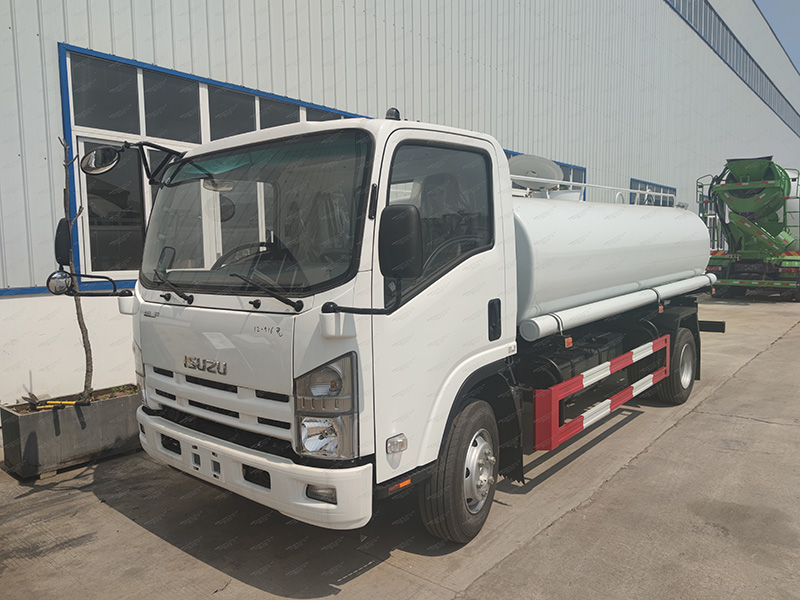
Light-Duty to Medium-Duty (2,000 to 4,000 Gallons)
Profile: Typically mounted on single or tandem-axle commercial chassis. These are standard vocational trucks built by major commercial manufacturers.
Ideal Applications: Urban construction, residential developments, municipal street sweeping support, and landscaping projects.
Pros: High maneuverability in tight spaces. Lower initial capital requirements. Easier to navigate on public roads and tight cul-de-sacs. Often avoids the most stringent heavy-haul regulations depending on the exact axle configuration.
Cons: Inefficient for large-scale earthmoving. Requires frequent refilling on large acreage sites, which drives up labor costs if the water source is not immediately adjacent to the work zone.
Heavy-Duty On-Highway (4,000 to 6,000 Gallons)
Profile: Typically configured on heavy-duty commercial chassis with axle arrangements, suspension systems, and frame ratings suited to the intended tank capacity. The final configuration must account for the combined weight of the chassis, tank, water, auxiliary equipment, and occupants while remaining within applicable vehicle weight limits.
Ideal Applications: Highway construction, large commercial site prep, and agricultural support.
Pros: Widely considered the industry sweet spot. Balances maximum legal road weight with high-volume delivery. Allows operators to cover large areas without sacrificing maneuverability entirely.
Cons: Requires strict adherence to GVWR limits. Demands experienced operators with specific CDL endorsements. The heavier footprint can cause rutting on poorly compacted subgrades.
Off-Highway and Articulated (8,000 to 10,000+ Gallons)
Profile: Built on articulated dump truck (ADT) or rigid frame mining truck chassis. These are dedicated off-road machines with massive flotation tires and specialized drivetrains.
Ideal Applications: Mining operations, quarry dust control, and massive infrastructure earthworks like dam construction or airport runways.
Pros: Unmatched volume delivery. Exceptional rough-terrain capability. Minimizes refill cycles on vast, isolated sites where water sources are miles apart.
Cons: Strictly prohibited from public roads. Massive capital investment required. Requires specialized maintenance programs and heavy-duty shop facilities to service the oversized components.
Water Truck Weight Limits and Safety Considerations
GVWR and Axle Load Limits for Safe Water Transport
Water is heavy. It weighs approximately 8.34 pounds per gallon. A 4,000-gallon tank adds over 33,000 lbs of liquid payload to the chassis. Calculate the loaded vehicle weight using the actual empty weight of the completed truck, including the installed tank and standard equipment, then add the water load, occupants, and any additional cargo. The resulting weight must remain within the vehicle's GVWR, while individual axle loads must also comply with their rated limits.
You must also comply with local bridge laws and per-axle weight limits if the truck operates on public roads. A tandem axle group is typically limited to 34,000 lbs on the highway. If your tank placement shifts too much weight to the rear axles, you will receive overweight citations even if the total vehicle weight is under the GVWR. Exceeding GVWR voids warranties, destroys suspensions, and creates massive liability risks in the event of a traffic collision.
Tank Shape and Center of Gravity for Vehicle Stability
Common tank profiles include elliptical, modified elliptical, and rectangular designs. Calculating volume using the specific shape dictates the required chassis footprint and installation space. The shape of the tank directly impacts how the truck handles on the job site.
Tank shape and mounting position influence the vehicle's center of gravity and overall stability. Elliptical and low-profile tank designs can help keep the liquid load relatively low, depending on their dimensions and installation height. Rectangular tanks may offer different packaging advantages, but their effect on stability depends on the complete tank and chassis configuration. Buyers should evaluate tank dimensions, mounting height, vehicle track width, and expected operating conditions when comparing designs for uneven terrain or sloped roads.
Terrain and Braking Requirements for Loaded Water Trucks
Steep grades and uneven terrain dictate your maximum safe capacity. A fully loaded truck requires significantly longer braking distances. Heavy liquid loads push the truck downhill, generating excessive transmission and brake heat on steep inclines. Brake fade occurs quickly when trying to stop 60,000 pounds of truck and water on a 10% grade.
Operators must adjust speeds and braking zones based on the payload. On sites with extreme grades, running a partially filled large tank is dangerous due to surge. It is often safer to utilize a smaller, fully loaded truck that matches the terrain's braking constraints rather than fighting a massive, surging load on a steep haul road.
Tank Baffles for Reducing Water Surge During Transport
Baffles are internal tank partitions. They are absolutely non-negotiable for safety. The free surface effect occurs when water surges back and forth in a partially empty tank during acceleration, braking, or cornering. This kinetic energy is massive. A 4,000-gallon tank half full has 16,000 pounds of water moving freely inside it.
Water movement inside a partially filled tank can affect vehicle handling during braking, acceleration, and cornering. Properly designed internal baffles help reduce liquid surge and improve load stability, although they cannot eliminate all movement. The number, orientation, and placement of baffles should be determined by the tank design, operating conditions, and applicable safety requirements. Drivers must still adjust their speed and braking practices to account for changing liquid loads.

Water Truck Compliance and Tank Construction Requirements
Operator Licensing and Compliance
In the United States, CDL requirements depend on the vehicle's Gross Vehicle Weight Rating (GVWR), actual operating weight, and vehicle configuration. A Class B CDL is generally required for a qualifying single vehicle with a GVWR or gross vehicle weight of 26,001 lbs or more. Because water adds substantial payload weight, contractors should verify the completed truck's weight rating and applicable licensing requirements before selecting a tank capacity.
Drivers operating qualifying CDL tank vehicles may also need a Tank Vehicle Endorsement (N Endorsement). Under federal rules, this generally applies to commercial motor vehicles carrying liquids or gases in tanks with an individual rated capacity greater than 119 gallons and an aggregate rated capacity of at least 1,000 gallons. Fleet operators should verify applicable federal and state requirements and ensure drivers have the appropriate qualifications before placing the vehicle into service.
Tank Materials and Reinforcement for Long-Term Durability
Tank material impacts overall weight and usable capacity. Steel is durable and heavy. It requires heavy-duty interior epoxy coatings to prevent rust, especially if drawing from corrosive or untreated water sources. If the epoxy fails, rust flakes will clog your spray nozzles and destroy your pump seals.
Aluminum is lighter, allowing for slightly more legal water capacity on the same chassis. However, aluminum is expensive and prone to cracking under severe off-road frame twisting. Polyethylene is lightweight and corrosion-resistant but limited in maximum capacity sizes compared to steel. Wall thickness is critical regardless of material. Specify heavy-duty, thick-grade materials for high-capacity tanks to prevent structural fatigue over years of rough service.
Conclusion
Calculate your daily volume requirements and cycle times based on site dimensions and water source proximity to establish a baseline capacity.
Filter your chassis options by terrain constraints, focusing on tank shape and center of gravity for off-road stability.
Verify GVWR limits and CDL requirements to ensure your current operator pool is legally certified to drive the selected equipment.
Conduct a site audit of available water sources to determine necessary pump filtration and fill rates.
Consult equipment dealers for payload-matched chassis recommendations, comparing the operational logistics between renting multiple smaller units versus purchasing one large unit.
FAQ
Q: How many gallons does a standard water truck hold?
A: A standard commercial water truck typically holds between 2,000 and 4,000 gallons. This size mounts easily on single or tandem-axle chassis, balancing maneuverability with sufficient volume for urban construction, dust control, and municipal tasks without requiring specialized heavy-haul permits.
Q: How do I calculate the water truck capacity needed for dust control?
A: Calculate the total square footage of the site requiring dust control. Determine the application rate based on soil type. Multiply the area by the application rate, then factor in the daily evaporation rate to find the total daily gallon requirement.
Q: How do you calculate the capacity of a custom water tank?
A: Measure the base area and height or length of the chassis footprint. Calculate the total volume based on the specific geometric shape of the tank. Finally, convert the resulting cubic feet measurement into gallons to determine the maximum liquid capacity.
Q: Do I need a CDL to drive a 4,000-gallon water truck?
A: Yes. A 4,000-gallon water truck fully loaded will exceed the 26,001 lbs Gross Vehicle Weight Rating (GVWR) threshold. Driving it requires a Commercial Driver’s License (CDL), typically Class B, along with a Tanker Endorsement (N Endorsement) to legally transport bulk liquids.
Q: How much does a full 2,000-gallon water truck weigh?
A: A full 2,000-gallon tank contains approximately 16,680 lbs of water, based on a water weight of 8.34 lbs per U.S. gallon. To calculate the total loaded truck weight, add this water load to the actual empty weight of the completed vehicle, including its tank and installed equipment, and account for occupants and additional cargo. The final weight varies by chassis and tank configuration and must remain within the vehicle's GVWR and axle ratings.
Q: What is the difference between on-highway and off-highway water trucks?
A: On-highway water trucks are designed for public-road operation and must meet applicable vehicle weight, dimension, and registration requirements. Off-highway water trucks are typically built for mining, quarrying, and large earthmoving sites, often using articulated or rigid heavy-equipment chassis. These vehicles may exceed normal road limits and generally require special transport arrangements or permits when moving between sites.
Q: Why are baffles important in large capacity water tanks?
A: Baffles are internal walls that prevent the free surface effect. When a truck brakes or turns, thousands of gallons of water surge forward or sideways. Baffles disrupt this kinetic energy, preventing the water's momentum from causing the truck to roll over or lose braking traction.


