


5,000L vs 30,000L Water Truck: How Capacity Changes the Job
Views: 0 Author: Site Editor Publish Time: 2026-11-23 Origin: Site


Different water truck sizes are suited to different project requirements, with 5,000L and 30,000L models offering distinct advantages in water capacity, maneuverability, and operating efficiency. A 5,000L water truck is generally better suited to urban construction, landscaping, and smaller sites where easy access is important. In contrast, a 30,000L model carries six times as much water per full tank, making it a potential option for large construction sites, mining operations, and high-volume dust suppression. However, larger tanks also increase vehicle weight and place greater demands on chassis capacity, road conditions, and site infrastructure. For contractors and fleet operators, selecting the right capacity requires comparing daily water demand, refill distance, site accessibility, and operating costs.
Key Takeaways
The Capacity Spectrum: While water truck sizes range from 325-gallon pickup slide-ins to 40,000L+ articulated mining haulers, the 5,000L and 30,000L models represent the two most critical operational extremes for standard commercial contractors.
Volume vs. Agility: A 5,000L water truck prioritizes site access and maneuverability for urban or constrained sites, whereas a 30,000L unit is built for endurance and high-efficiency operations on large-scale civil or mining projects.
Regulatory Thresholds: Stepping up to a 30,000L capacity drastically changes Gross Vehicle Weight (GVW), requiring specialized heavy-duty chassis, commercial driver’s licenses (CDL), and tanker endorsements.
Cycle Time Economics: The true value of a larger tank is realized only when the distance to the water source justifies the heavier payload; otherwise, the fuel and maintenance costs of moving a 30,000L truck negate the volume advantage.
Infrastructure Impact: Fully loaded 30,000L trucks exert massive ground pressure, requiring engineered haul roads to prevent soil degradation and vehicle recovery scenarios.
Table of Contents
Comparing Different Water Truck Sizes and Their Features
Defining the mechanical and structural differences across the spectrum of standard equipment sets the stage for proper fleet selection. Tank volume dictates the chassis size, the pump system, and the physical footprint of the machine. You cannot simply place a larger tank on a standard truck frame. The engineering scales exponentially with the liquid weight.
Common Water Truck Capacity Ranges and Applications
Before analyzing the extremes, look at the standard categories of mobile water delivery systems used in the field.
Light-Duty: Small pickup tanks hold approximately 325 gallons. Crews use these slide-in units for minor landscaping, localized dust control, or remote trail maintenance where full-sized vehicles cannot fit.
Mid-Range: Standard construction and fire service carriers hold between 8,000L and 15,000L (2,000 to 4,000 gallons). They offer a reliable balance of payload and mobility for general municipal work and mid-sized commercial grading.
Heavy-Duty & Extreme: Large construction, haulage, and mining tankers carry 20,000L to 40,000L or more. Manufacturers design these strictly for maximum volume and continuous high-output delivery on dedicated haul roads.
5,000L Water Trucks for Easy Access and Urban Operations
A 5,000L unit prioritizes movement and accessibility. Manufacturers typically mount these tanks on medium-duty commercial chassis, such as Class 5 or Class 6 trucks. The lighter frame allows for standard street operation without triggering heavy-haul restrictions. The short wheelbase provides tight turning radii. This makes the truck highly effective in confined spaces.
Primary use cases include urban construction, residential dust suppression, landscaping, and tight-access municipal work. Operators can navigate narrow residential streets, cul-de-sacs, and crowded commercial building sites. The operational footprint remains minimal. Compared with a fully loaded 30,000L truck, a 5,000L model generally places less total load on the site and may be more suitable for areas with limited access or lower ground-bearing capacity. However, operators must still verify soil conditions, axle loads, and tire contact pressure before driving on uncompacted or newly prepared surfaces.
Mechanically, these trucks often utilize PTO-driven centrifugal pumps or independent gas-powered pumps. Because the tank volume is relatively low, the internal baffling system is simpler. The dynamic shift of 5,000 liters of water is manageable for a standard medium-duty suspension system.
30,000L Water Trucks for High-Volume Industrial Operations
A 30,000L unit represents heavy industrial capability. This capacity requires heavy-duty, multi-axle vocational trucks. In off-road scenarios, it requires articulated chassis frames converted from rock trucks. The sheer mass of the water demands robust suspension systems, reinforced axles, and high-torque powertrains. These machines are not designed for tight corners or fragile ground.
Primary use cases include mining operations, major highway construction, large-scale agricultural irrigation, and bulk liquid haulage. On a mass grading site, endurance is the primary goal. You need to put down massive amounts of water to achieve soil compaction across acres of exposed dirt.
Differentiate between a sprinkler truck and a bulk tanker. A 30,000L sprinkler truck features high-efficiency spray heads, water cannons, and heavy-duty PTO-driven pumps for active site application. A standard road tanker is a semi-trailer used purely for bulk liquid transport from a municipal hydrant to a remote staging area. The operational footprint of a 30,000L active sprinkler truck demands wide operational lanes. It requires engineered, reinforced haul roads and significant stopping distances due to the dynamic liquid surge.
Feature / Specification | 5,000L (1,320 Gal) Profile | 30,000L (7,925 Gal) Profile |
|---|---|---|
Chassis Class | Medium-Duty (Class 5 or 6) | Heavy-Duty (Class 8) / Articulated Off-Road |
Maneuverability | High (Short wheelbase, tight turning) | Low (Requires wide lanes, large turning radius) |
Primary Application | Urban sites, residential, light dust control | Mining, highway construction, mass grading |
Ground Pressure | Low to Moderate (Safe for fragile surfaces) | Extreme (Requires engineered haul roads) |
Refill Frequency | High (Requires close proximity to water source) | Low (Built for endurance and long cycle times) |
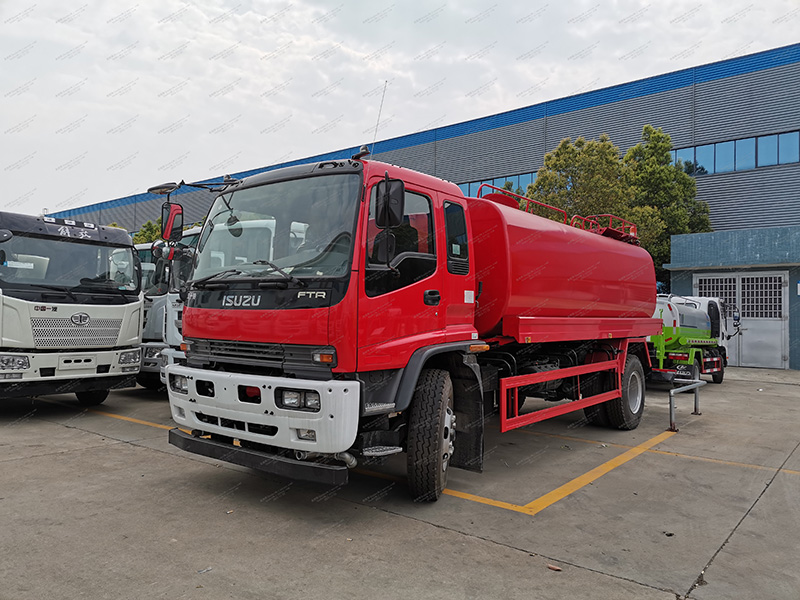
How Water Truck Capacity Affects Job Site Operations
Tank volume translates directly to daily operational workflows. The size of the tank dictates how long an operator can spray before returning to the source. It dictates the pump size required to move the water. It determines whether the truck is better suited for surface dust suppression or deep soil compaction.
Cycle Times, Refill Frequency, and Drafting
Analyzing the math of water application reveals the true impact of tank capacity. You must compare Gallons Per Minute (GPM) output against total capacity. A standard 3-inch or 4-inch water pump can easily output 300 to 500 GPM. If an operator runs a 5,000L (1,320-gallon) truck with the pump wide open, the tank runs dry in under four minutes. This requires immediate refilling.
Calculating the break-even distance is a critical site management task. You must determine when the time saved by carrying 30,000L outweighs the slower transit speed. A 5,000L truck can make multiple fast trips if the hydrant is on the same city block. When the water source is several miles from the active work area, a 5,000L truck may spend a substantial portion of its working time traveling between the site and the refill point. A 30,000L truck can reduce the number of refill trips, provided that site access, road conditions, filling capacity, and operating costs support the use of a larger vehicle.
Rural and remote crews often utilize continuous drafting strategies. They set up portable staging pools near the active work zone. Smaller trucks draft water continuously from these pools using suction hoses. Meanwhile, larger road tankers run bulk relay routes from the distant municipal source to keep the pools full. This keeps the nimble spray trucks working without long transit delays. Managing high-volume output requires specific pump and spray head configurations. A 30,000L truck often utilizes variable-flow nozzles and independent spray zones to prevent immediate depletion while maintaining wide coverage.
Water Application for Dust Suppression and Soil Compaction
Dust suppression and soil compaction require entirely different water application strategies. Dust suppression requires a continuous, light-layer application. You want to wet the surface to prevent airborne particulates without turning the haul road into mud. The 5,000L units excel here. They maneuver through confined zones, lightly spraying the surface without over-saturating the ground. Their lighter weight prevents them from destroying the very surface they treat.
Soil compaction requires deep moisture penetration. When contractors lay down thick 12-inch lifts of dirt for mass grading, the soil must reach optimal moisture content to pass Proctor compaction testing. A light surface spray evaporates before the sheepsfoot roller compactor can do its job. A 30,000L water truck may be suitable for large earthmoving projects where substantial water volumes are needed to condition soil before compaction. However, the required water application rate depends on soil characteristics, existing moisture content, lift thickness, and project specifications. The truck supplies water for moisture conditioning, while dedicated compaction equipment is responsible for achieving the specified soil density.
Vehicle Weight Limits and Operating Requirements
Water is exceptionally heavy. The legal and physical limitations imposed by water weight dictate where and how you can operate these vehicles. One liter of water weighs exactly one kilogram. One gallon of water weighs 8.34 pounds. This static fact changes everything about site logistics.
GVWR and Axle Load Limits for Safe Water Transport
Volume calculations must account for liquid density. Fuel tankers often hold 5,500 to 11,600 gallons because diesel and gasoline are significantly lighter than water. Water maximizes axle weight limits rapidly. A 5,000L tank adds approximately 5,000 kg (11,000 lbs) of dynamic liquid weight to the chassis. A 30,000L tank adds approximately 30,000 kg (66,000 lbs) of water weight.
When you add 66,000 lbs of water to a heavy-duty truck chassis that already weighs 30,000 lbs, the Gross Vehicle Weight easily approaches 100,000 lbs. Navigating bridge weight limits becomes a daily challenge. Local road restrictions strictly govern where a fully loaded 30,000L truck can travel. Seasonal weight bans, especially during spring thaws, can completely ground heavy-duty equipment. Site managers must plan dedicated routes to avoid collapsing municipal infrastructure.
Driver Licensing Requirements for Different Truck Sizes
In the United States, CDL requirements depend on the vehicle's Gross Vehicle Weight Rating (GVWR), actual operating weight, and configuration. A fully loaded 30,000L water truck generally requires a CDL when operated on public roads because of its substantial weight. Drivers of qualifying commercial tank vehicles may also need a Tank Vehicle Endorsement (N Endorsement). Air brake operation is addressed through CDL testing and applicable license restrictions rather than a separate federal air brake endorsement.
A 5,000L water truck may be easier to operate and maneuver than a 30,000L model, but its smaller tank does not automatically exempt the driver from CDL requirements. Fleet operators should verify the completed vehicle's weight ratings, tank configuration, and applicable licensing rules before assigning drivers. Driver training should also cover liquid surge, braking, load distribution, and safe operation under the expected site conditions.
Ground Conditions and Haul Road Requirements for Heavy Trucks
Large trucks carry a hidden physical toll on the job site itself. Fully loaded 30,000L trucks exert massive ground pressure. This leads to rutting, soil shear, and the degradation of the haul road. If the site does not have engineered, highly compacted haul roads, a 30,000L truck will sink.
Continuous road maintenance becomes a necessity. You often have to deploy a motor grader specifically to repair the damage caused by the heavy water tanker. Liquid surge mitigation is critical. As a 30,000L tank empties, the remaining water sloshes violently during transit. Internal tank baffles can help reduce liquid movement during braking, acceleration, and cornering. Their design and arrangement should match the tank configuration and intended operating conditions, while drivers must still account for liquid surge and vehicle stability when traveling over uneven terrain.

Common Water Truck Sizing Problems and Practical Solutions
Procuring the wrong equipment creates bottlenecks that ripple through the entire production schedule. Understanding common implementation failures helps fleet managers avoid costly mismatches between equipment and site conditions.
Oversized Water Truck Capacity Leads to Unnecessary Operating Costs
Buying the largest available tank is a common mistake. The risk of over-specifying involves deploying a 30,000L truck on a site that lacks the infrastructure to support its weight. If the site features tight residential corners, the massive truck will not have the turning radius to maneuver. It spends more time backing up and repositioning than actually spraying water. If the ground is soft, the truck gets stuck, requiring an excavator to pull it out.
Mitigation requires a thorough site audit before equipment deployment. Measure the actual turning radiuses of the access roads. Test the road compaction to ensure it can support heavy axle loads. Calculate the actual daily water volume requirements. If the site only needs 10,000 liters a day for basic dust suppression, bringing in a 30,000L unit is entirely unnecessary.
Undersized Water Truck Capacity Causes Frequent Refilling and Delays
Under-specifying capacity is equally detrimental. The risk involves utilizing a small 5,000L truck on a massive grading site. The truck empties its tank in minutes and spends hours driving back and forth to the hydrant. This results in equipment queuing. Scrapers, dozers, and compactors sit idle, waiting for the dirt to reach optimal moisture. Dry material halts production.
Mitigation involves mapping the exact distance to the water standpipe or hydrant. Calculate the transit time. If the refill transit takes longer than the actual spray time, you have a logistical failure. You must scale up the tank capacity. Alternatively, deploy portable staging pools and utilize a relay system to keep the smaller truck supplied without leaving the work zone.
Mid-Range Water Truck Capacity Balances Water Supply and Maneuverability
Sometimes the extremes are not the answer. Evaluating the 8,000L to 15,000L (approx. 2,000 to 4,000 gallon) middle ground often solves complex site challenges. These mid-range models offer the best balance for most standard commercial buyers.
A 15,000L truck provides enough capacity for moderate civil work, road construction, and continuous dust suppression. It reduces refill trips significantly compared to a 5,000L unit. It avoids triggering the extreme infrastructure damage and heavy-haul CDL hurdles associated with a 30,000L unit. Mid-range trucks navigate standard suburban streets while still carrying enough payload to keep a compaction crew moving efficiently.
Conclusion
The choice between a 5,000L and 30,000L water truck requires strict alignment of equipment capability with site geography, water source proximity, and overall project scale. A massive tank is useless if it sinks in the mud. A nimble truck is useless if it spends all day driving to the hydrant. Choose the 5,000L unit for urban environments, fragile surfaces, short-term projects, and sites with immediate access to municipal hydrants. Choose the 30,000L unit for mass excavation, mining, remote sites with distant water sources, and high-efficiency operations where maximizing water output is critical to production.
To finalize your equipment selection, take the following actionable steps:
Calculate your required daily water volume based on the total square footage of the active work zone and the depth of the soil lifts.
Measure the exact transit distance and expected travel time from the primary water source to the application area.
Assess site ground conditions and haul road compaction levels to ensure they can physically support heavy axle loads without constant grading repairs.
Consult with an equipment specialist to review chassis availability, pump configurations, and local weight regulations for your specific region.
FAQ
Q: What are the most common water truck sizes?
A: Water truck sizes vary widely based on application. Small pickup tanks hold about 325 gallons. Mid-range construction and fire service carriers hold 2,000 to 4,000 gallons (8,000L to 15,000L). Large off-road or mining tankers carry 8,000 to 10,000+ gallons (30,000L to 40,000L).
Q: How much does a 30,000L water truck weigh when full?
A: 30,000 liters of water weighs exactly 30,000 kg (roughly 66,000 lbs). When added to the tare weight of a heavy-duty chassis and tank, the Gross Vehicle Weight (GVW) easily exceeds 80,000 lbs. This extreme weight requires specialized axles and careful route planning.
Q: Do I need a CDL to drive a water truck?
A: In the United States, a CDL is generally required for qualifying single vehicles with a GVWR or actual gross vehicle weight of 26,001 lbs or more, subject to applicable exceptions. Drivers of CDL-required tank vehicles may also need an N Endorsement when the tank configuration meets federal requirements. Licensing rules vary by country and jurisdiction, so operators should verify local requirements before using the truck.
Q: How long does it take to empty a 5,000L vs. 30,000L water tank?
A: Spray time depends entirely on the pump's GPM rating. A standard 5,000L truck can empty in 10 to 15 minutes of continuous spraying. A 30,000L truck may take 30 to 45 minutes depending on the spray head configuration and pump output settings.
Q: What is the difference between a water truck and a water tanker?
A: A water truck is often equipped with pumps, spray bars, or water cannons for applications such as dust suppression, road maintenance, and soil conditioning. A water tanker primarily focuses on transporting water between locations and may use either a rigid truck chassis or a trailer configuration. The distinction depends mainly on the vehicle's intended function and equipment rather than its chassis type alone.
Q: How do I calculate the right water truck capacity for my job site?
A: Divide your total daily water requirement by the acceptable number of refill trips. Factor in the cycle time to the water source. If the cycle time is long, you will need a larger capacity truck or a portable relay system to maintain efficiency.


