


Garbage Truck Capacity Explained: CBM, Payload and Compaction Ratio
Views: 0 Author: Site Editor Publish Time: 2026-11-23 Origin: Site


Garbage truck capacity is determined by three key factors: body volume (CBM), payload capacity, and compaction ratio. Body volume indicates how much space is available for waste, payload capacity determines how much weight the truck can safely and legally carry, and compaction ratio describes how much waste volume can be reduced during loading. For municipal waste collection and commercial hauling operations, these factors affect how much waste a truck can collect before unloading. Understanding their relationship helps fleet managers compare truck specifications, avoid overloading, and select suitable vehicles for different waste types and collection routes.
Key Takeaways
Volumetric capacity (CBM/Cubic Yards) dictates physical space, but Gross Vehicle Weight (GVW) and axle limits strictly dictate legal payload.
Compaction ratios (typically ranging from 3:1 to 6:1 depending on the truck type) directly determine how much actual waste density can be packed into the available volume.
Intelligent compaction and automated systems can achieve 90%+ load efficiency while delivering up to a 23% improvement in fuel efficiency over non-automated models.
Matching cart capacity (gallons) to truck volume requires specific conversion formulas to accurately forecast route completion rates.
Over-specifying body displacement on an underrated chassis is the most common cause of premature mechanical failure and compliance violations.
Table of Contents
Three Key Factors That Determine Garbage Truck Capacity
Procurement teams often look straight at the size of the hopper and the body. This narrow view ignores the difference between what a garbage truck holds physically and what it holds legally. Evaluating a vehicle based only on its physical dimensions creates severe operational bottlenecks on the route. You must understand how volume, weight, and material density interact to determine true operational capability. A truck that looks massive on the dealer lot might be legally overweight when only half full of wet refuse.
Body Volume (CBM) Determines Available Loading Space
Body displacement volume represents the total internal physical space of the collection body. Manufacturers measure this space in cubic meters (CBM) or cubic yards (CYD). Sizes range drastically based on the intended application. Urban mini-packers often feature a compact 5 cbm body to navigate narrow alleyways and tight turning radiuses. Heavy-duty commercial route trucks frequently exceed 25 cbm to handle massive daily volumes from industrial parks and large retail centers.
Volumetric capacity sets the absolute ceiling for uncompacted waste. It dictates the physical footprint of the vehicle. A larger CBM requires a longer wheelbase and a heavier chassis frame. However, filling a 25 cbm body does not guarantee you have maximized your route efficiency. Physical space only matters if you have the legal weight allowance to fill it completely. If your route consists of heavy materials, that extra physical space remains empty, meaning you paid for steel and hydraulics you cannot legally use.
Vehicle Weight Ratings Limit How Much Waste Can Be Carried
Gross Vehicle Weight (GVW) is the absolute maximum operating weight of the vehicle. It includes the chassis, the steel body, hydraulic fluids, crew members, fuel, and the collected waste. Regulatory bodies strictly enforce GVW limits to protect roadway infrastructure from excessive wear and tear.
To estimate the truck's rated payload capacity, subtract the actual empty weight of the completed vehicle from its Gross Vehicle Weight Rating (GVWR). The empty weight should include the installed refuse body, hydraulic equipment, fuel, and other permanent components, while the remaining capacity must also accommodate crew members and collected waste. The final allowable waste payload may be further restricted by axle ratings and applicable road weight limits. Heavier-duty chassis generally offer higher weight ratings, but their actual payload capacity depends on the completed vehicle configuration.
Axle configurations play a massive role in weight distribution. Single rear axles carry less weight than tandem rear axles. A standard single drive axle might max out at 20,000 to 23,000 lbs, while a tandem setup can handle 34,000 to 46,000 lbs. Specifying the correct chassis ensures you have the legal weight allowance to utilize your body's full volumetric capacity without risking overweight citations at the weigh station.
Waste Density Affects How Much Waste Fits Within Weight Limits
Waste density transforms volumetric space into actual payload weight. Different material streams possess vastly different baseline densities. Uncompacted municipal solid waste can vary considerably in density depending on its composition, moisture content, and collection conditions. Loose recyclable materials such as plastic bottles and cardboard generally occupy more space relative to their weight, while wet organic waste and food scraps can produce heavier loads within the same body volume. Procurement teams should use actual waste density measurements or reliable local collection data when estimating payload requirements.
A 20 cbm truck carrying wet organics will hit its legal payload weight limit long before it fills its volumetric capacity. The truck might look half empty to the driver, but adding more material violates DOT weight regulations. Conversely, a truck collecting dry cardboard might fill every cubic inch of its 20 cbm body while remaining thousands of pounds under its legal GVW limit. Understanding your specific waste density is non-negotiable for accurate capacity planning. You must match the truck's weight rating to the heaviest material it will encounter on its assigned route.
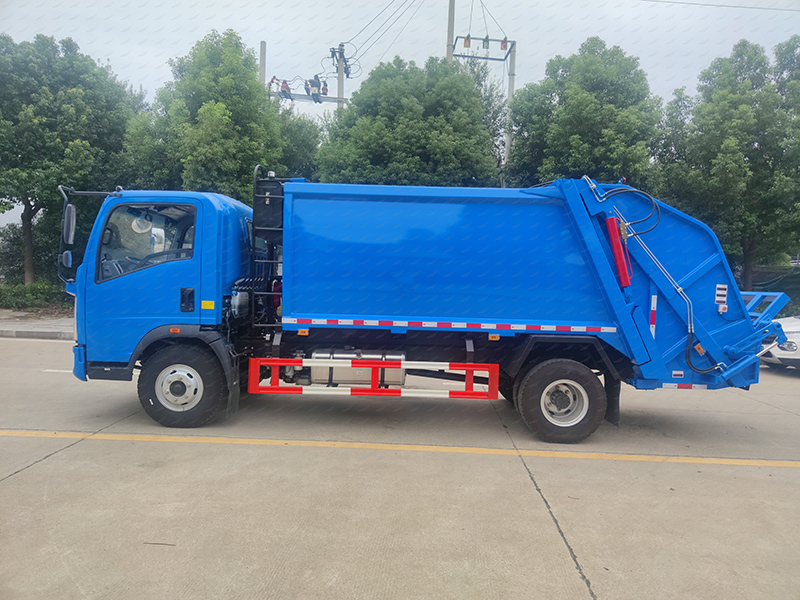
The Impact of Compaction Ratios on Actual Payload
Different refuse compactor trucks utilize varying hydraulic packing mechanisms. These systems optimize payload and achieve maximum load efficiency. Compaction ratios determine how tightly the vehicle squeezes the collected material, directly impacting how many stops a driver can make before heading to the transfer station.
Standard Compaction Ratios by Garbage Truck Type
Compaction capabilities vary significantly based on the body style and the hydraulic system design. Manufacturers engineer different trucks for specific material streams.
Truck Type | Typical Volume (CBM) | Average Compaction Ratio | Ideal Application |
|---|---|---|---|
Rear Loader | 10 - 25+ | 4:1 to 6:1 | Mixed MSW, Bulky Items, Yard Waste |
Automated Side Loader | 15 - 30 | 3:1 to 5:1 | Standardized Residential Cart Routes |
Front Loader | 20 - 40 | 4:1 to 6:1 | Commercial Dumpsters, Cardboard |
Rear loaders offer exceptional versatility for mixed residential and commercial routes. Typical compaction capabilities range from 600 to 1,000 pounds per cubic yard. The heavy-duty sweep-and-slide blade crushes household bags, yard waste, and bulky furniture alike. This makes them the standard choice for municipalities dealing with unpredictable waste streams.
Automated side loaders (ASL) dominate standardized residential cart collection. They prioritize speed and continuous packing over maximum crushing force. Compaction ratios are generally slightly lower than rear loaders, typically achieving 500 to 800 pounds per cubic yard. The automated arm provides massive speed advantages, allowing a single operator to service hundreds of homes quickly, offsetting the slightly lower density.
Front loaders handle heavy, bulky waste from commercial dumpsters. They pack material horizontally from the hopper to the rear tailgate. Compaction ratios often reach 800 to 1,000 pounds per cubic yard. The horizontal packing cylinders generate immense force, ideal for crushing cardboard boxes, wooden pallets, and dense commercial refuse.
How Hydraulic Packing Systems Maximize Load Efficiency
Modern refuse bodies rely on complex hydraulic mechanics. The most common design is the sweep-and-slide blade system. Hydraulic cylinders push a massive steel blade through the hopper. The blade sweeps the loose material and slides it deep into the body cavity. Continuous pressure forces the air out of the waste, increasing its density and freeing up hopper space for the next stop.
Some modern garbage compactor trucks use electronic controls and hydraulic pressure monitoring to manage packing cycles. These systems can adjust the operation of the compaction mechanism according to resistance and operating conditions, helping improve packing consistency and reduce unnecessary hydraulic cycling. However, hydraulic pressure monitoring does not replace actual payload measurement or axle weight checks. Fleet operators should evaluate compaction performance, energy consumption, and load monitoring capabilities based on the specific equipment configuration and manufacturer's technical data.
Higher Compaction Demands and Their Impact on Vehicle Maintenance
Higher compaction ratios increase route efficiency. Packing more material into the same space means fewer trips to the landfill, saving fuel and driver hours. However, this efficiency comes with mechanical trade-offs. Achieving extreme compaction requires heavier hydraulic cylinders, thicker steel-reinforced bodies, and larger fluid reservoirs.
These heavier components increase the vehicle's tare weight. A higher tare weight directly reduces the available legal payload for the waste itself. You trade legal waste capacity for heavier steel. Additionally, aggressive compaction impacts fuel consumption during idle. The engine must rev higher to power the Power Take-Off (PTO) and drive the hydraulic pumps. Constant high-pressure packing also accelerates hydraulic system wear. Hoses, seals, and cylinders degrade faster under maximum pressure, requiring more frequent maintenance and increasing downtime.
Matching Garbage Truck Capacity to Collection Route Requirements
Translating technical specifications into operational outcomes requires analyzing your specific collection environment. A truck perfectly specified for a sprawling suburban neighborhood will fail miserably on a dense downtown commercial restaurant route.
Residential vs. Commercial Route Requirements
Residential recycling routes present a high-volume, low-weight reality. Trucks fill up with uncrushed plastic bottles, aluminum cans, and cardboard quickly. You need maximum CBM to hold the bulky material, but you rarely challenge the chassis GVW limits. A lighter chassis paired with a massive body works perfectly here. You maximize physical space without paying for heavy-duty axles you do not need.
Commercial food waste or construction debris presents a high-density reality. The material is incredibly heavy. A large body is useless because the truck will exceed its legal axle weight limits long before the hopper is full. For these routes, you need a heavy-duty Class 8 chassis, reinforced tandem axles, and a smaller, highly reinforced body. A 16 cbm body on a heavy chassis outperforms a 25 cbm body on a medium chassis when hauling wet food waste.
Calculating Cart Capacity to Truck Volume
Forecasting route completion rates requires converting household cart sizes into truck volume. The industry utilizes a standard conversion framework. You convert cart capacity in gallons to cubic yards by dividing the gallon quantity by 202. The formula is: X Gallons / 202 = Cart Capacity in CYD.
For example, a 96-gallon residential cart has a nominal volume of approximately 0.47 cubic yards (96 ÷ 202). A truck with 20 cubic yards of usable body capacity and an assumed 4:1 compaction ratio could theoretically accommodate about 80 cubic yards of loose waste, equivalent to approximately 170 fully filled 96-gallon carts by volume. However, this is only a simplified planning estimate. Actual collection capacity depends on cart fill levels, waste composition, achievable compaction, usable body volume, and legal payload limits. Fleet managers should verify these estimates against actual route and vehicle performance data.
Axle Limits and Bridge Formula Compliance
Total GVW is only half the legal equation. Weight distribution matters immensely. A truck may sit under its total GVW limit but violate the legal weight limit on its rear axles. Waste distribution within the body can affect the truck's center of gravity and the load carried by each axle. Depending on the compaction mechanism, body layout, and loading conditions, a truck may exceed an individual axle limit even when its total weight remains within the vehicle's GVWR.
Federal and local bridge formulas dictate how much weight can rest on a single axle or a tandem axle grouping based on the distance between them. Larger capacity trucks, specifically those in the 20-25 cbm range, often require drop axles. Pusher axles sit in front of the drive axles, while tag axles sit behind them. Deploying these extra axles spreads the vehicle's weight over a larger footprint on the pavement. This maintains regulatory compliance, protects bridges, and prevents costly DOT fines during roadside inspections.

Common Garbage Truck Capacity Problems and Their Operational Impact
Identifying where fleet procurement goes wrong saves thousands of dollars in operational penalties. Avoiding costly specification errors requires vigilance during the purchasing phase. Do not rely solely on glossy brochures; look at the engineering data.
Differences Between Advertised and Usable Body Capacity
Assuming the advertised CBM equals 100% usable space is a massive risk. Manufacturers often advertise the total internal volume of the steel shell. However, the hopper size, internal blade displacement, and tailgate design significantly reduce the actual cargo payload area. The sweep blade and hydraulic cylinders take up physical space inside the body.
Always verify the actual offered vehicle's usable load-area dimensions. Request a payload demonstration before finalizing procurement. Ask the manufacturer for the exact cubic yardage available for compacted waste, excluding the hopper and hydraulic sweep intrusion. If a 20 cbm truck only offers 17 cbm of usable packing space, your route calculations will be entirely inaccurate.
Oversized Garbage Truck Bodies Increase Overloading Risks
Mounting a massive compactor body on a chassis with an insufficient GVW rating creates a legal nightmare. This leads to a truck that can legally only be filled halfway. If drivers fill the body completely, the vehicle becomes dangerously overweight. Overweight trucks suffer from severe brake fade, accelerated tire wear, and broken suspension components.
Always calculate the worst-case scenario waste density against the chassis payload capacity before finalizing the body size. If your route includes heavy, wet yard waste, specify a heavier chassis or reduce the body size. Never assume a larger body automatically equals more route capacity. A balanced truck performs better and lasts longer than an oversized body on a weak frame.
Seasonal Changes in Waste Density Affect Payload Planning
Waste density fluctuates wildly throughout the year. Yard waste season introduces heavy, wet grass clippings and dense branches. Heavy rains soak exposed trash in open dumpsters, drastically increasing its weight. Trucks operating safely within legal limits during dry winter months suddenly become overweight in the spring.
Allow a suitable payload margin based on historical route weights, seasonal changes in waste density, and applicable vehicle weight limits. Do not spec a truck to operate at 99% of its legal GVW on an average day. Leave room for seasonal density spikes to ensure year-round compliance. A truck that gets parked because it fails DOT weight checks during the rainy season is a wasted asset.
High-Capacity Compactors Place Greater Demands on Maintenance
Maximizing capacity through extreme compaction increases mechanical stress across the entire vehicle. The packer blade, hydraulic hoses, and PTO endure immense pressure during every cycle. Pushing a 6:1 compaction ratio on heavy commercial waste accelerates metal fatigue and hydraulic seal degradation.
Establish strict periodic maintenance schedules. Specify heavy-duty hydraulic packages for high-density routes. Upgrade to premium hydraulic fluid cooling systems to prevent overheating during continuous summer operation. Hot hydraulic fluid loses viscosity, reducing packing force and damaging pumps. Proper maintenance mitigates the wear associated with high-capacity packing and keeps the truck on the route instead of in the shop.
Steps to Match Garbage Truck Capacity with Your Collection Needs
Selecting the perfect vehicle requires a systematic approach. Follow this step-by-step decision matrix to ensure your procurement aligns with operational reality.
Step 1: Review Waste Volume and Weight Data from Your Routes
Never rely on manufacturer estimates for waste density. Pull scale tickets from your existing routes. Analyze the data over a full twelve-month period to capture seasonal variations. Determine your exact average payload weights and calculate your specific waste densities. Hard data drives accurate procurement. If your average payload is 12,000 lbs, spec a truck that handles 14,000 lbs comfortably.
Step 2: Match Compaction Systems to the Waste You Collect
Align the body style and target compaction ratio with your specific material stream. Choose automated side loaders for standardized residential MSW to maximize stops per hour. Select front loaders for commercial cardboard and dumpsters to handle bulky items. Match the hydraulic packing force to the resistance of the material you collect daily.
Step 3: Align with Local Infrastructure and Regulations
Ensure the selected CBM and chassis length can physically navigate your route constraints. Long wheelbases struggle in tight cul-de-sacs and historic downtown alleys. Verify compliance with local Department of Transportation (DOT) axle weight laws.
Finally, verify that the truck's maximum GVW and height clearance are compatible with your destination facilities. Check the height restrictions at transfer station tipping floors. Confirm the maximum weight limits on landfill scales. A truck that cannot legally enter the landfill or clear the transfer station doors is useless.
Conclusion
Garbage truck capacity is not a static number. It remains a dynamic calculation requiring the perfect balance of chassis GVW, body CBM, and hydraulic compaction. A successful fleet procurement strategy demands rigorous data analysis and a deep understanding of route-specific variables.
Audit your historical scale tickets to determine the exact waste density of your specific routes before looking at manufacturer brochures.
Calculate the required legal payload based on your heaviest seasonal waste variations, ensuring you build in a 10-15% weight buffer.
Select a chassis GVW and axle configuration that legally supports your target payload without relying on maximum volumetric capacity alone.
Consult with both the chassis dealer and the refuse body builder simultaneously to verify weight distribution and bridge formula compliance.
Request a physical payload demonstration to confirm the usable load-area dimensions match your route completion forecasts.
FAQ
Q: How is garbage truck capacity measured?
A: Capacity utilizes dual metrics. Volumetric capacity measures the physical space inside the body in cubic yards or cubic meters (CBM). Payload capacity measures the legal weight limit the truck can carry, determined by subtracting the vehicle's empty tare weight from its Gross Vehicle Weight (GVW).
Q: What is the standard compaction ratio of a rear loader garbage truck?
A: Rear loaders typically achieve compaction ratios between 4:1 and 6:1. This powerful hydraulic packing system crushes mixed municipal solid waste and bulky items, generally achieving a density of 600 to 1,000 pounds per cubic yard inside the body.
Q: How many cubic yards are in a standard garbage truck?
A: Volumetric sizes vary widely based on application. Urban mini-packers start around 5 cbm (roughly 6.5 cubic yards). Standard residential and commercial trucks typically range from 15 to 25+ cbm (20 to 33 cubic yards), with heavy-duty models exceeding these limits.
Q: How do you calculate payload from GVW?
A: Estimate the available payload by subtracting the completed truck's empty weight from its Gross Vehicle Weight Rating (GVWR). Then account for the weight of crew members and any additional equipment or supplies. The allowable waste payload must also comply with axle weight ratings and applicable road regulations, which may impose a lower limit than the GVWR calculation alone.
Q: What is the difference between CBM and payload?
A: CBM (Cubic Meters) dictates the physical, volumetric space available inside the truck's hopper and body. Payload dictates the legal weight limit of the material the truck can carry on the road without violating Department of Transportation axle and GVW regulations.
Q: How many residential carts can a garbage truck hold?
A: Calculate this by converting cart gallons to cubic yards (Gallons / 202). Multiply the truck's usable cubic yardage by its compaction ratio to find total uncompacted capacity. Divide the total uncompacted capacity by the cart's cubic yardage to estimate the total number of stops.


