


Garbage Compactor Truck: Capacity, Applications and Buying Guide
Views: 0 Author: Site Editor Publish Time: 2026-11-09 Origin: Site


A garbage compactor truck collects waste, compresses it inside an enclosed body, and transports it to a transfer station or disposal facility. Compaction helps use the available storage space more effectively, but the truck must still operate within its permitted weight and axle limits.
For municipalities, sanitation contractors, and private waste operators, choosing the right truck involves more than comparing cubic meters. Waste density, container compatibility, street access, unloading arrangements, and maintenance support all affect daily performance.
This guide explains how compactor trucks work, how to assess their capacity, and what to confirm before requesting a quotation.
Table of Contents
How Does a Garbage Compactor Truck Work?
Main components and collection process
A typical compactor truck combines a truck chassis with a collection body, loading hopper, hydraulic packing mechanism, and discharge system. Depending on the configuration, it may also include a bin lifter, liquid collection tank, and external operating controls.
During collection, waste enters the hopper manually or through a compatible container-lifting system. The hydraulic mechanism moves the waste into the storage body and compresses it as loading continues.
The exact mechanism varies. Many rear loaders use a packing blade and sliding assembly, while other designs use different arrangements. Buyers should request a demonstration of the proposed model rather than assume that every compactor operates in the same way.
Compaction and unloading
Compaction reduces the space occupied by compressible waste. It can help a truck collect more loose material before the body fills, provided sufficient payload capacity remains.
At the unloading location, many rear loaders raise the tailgate and discharge the load using an ejector panel. Other designs may use a tipping body. Confirm the discharge method, required working clearance, and site conditions before selecting the vehicle.
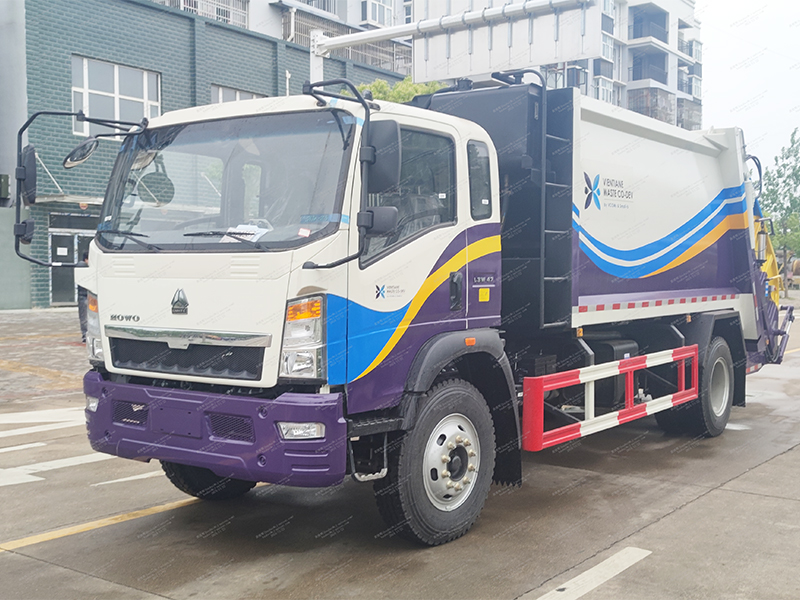
CJ Vehicle’s HOWO garbage compactor truck provides an example of a hydraulic compactor configuration. Request the current specification sheet and operating instructions for the exact vehicle offered.
Waste suitability and liquid management
General household waste and suitable commercial refuse are common applications. However, the acceptable waste stream depends on the body and loading equipment.
Dense rubble, large metal objects, hazardous materials, and other unsuitable items can damage the mechanism or require separate collection. Bulky items should only be accepted within the equipment’s stated handling limits.
Wet waste also needs attention. Check the hopper drainage, tailgate sealing, liquid collection arrangement, and cleaning access. A collection tank has limited capacity and needs an operating procedure for inspection and emptying.
Understanding Garbage Compactor Truck Capacity
Body volume, hopper volume, and payload
Capacity figures can describe different parts of the vehicle. A useful comparison separates the following:
Capacity term | What it means | What buyers should confirm |
|---|---|---|
Body volume | Nominal storage space inside the collection body | Measurement method and whether the hopper is excluded |
Hopper volume | Space receiving waste before it is packed | Compatibility with the loading method and collection pace |
Waste payload | Waste mass the complete vehicle can carry within applicable limits | Complete vehicle weight and axle distribution |
Compaction ratio | Reduction in waste volume under stated conditions | Test material, loading conditions, and measurement method |
Daily collection capacity | Total waste collected over a working day | Number of trips, route time, and unloading delays |
A larger body does not automatically provide a higher usable waste payload. Additional body structure, lifting equipment, and other options also add vehicle weight.
Calculate payload from the complete vehicle
A preliminary payload calculation is:
Available waste payload = applicable gross weight limit − ready-to-work vehicle weight
The ready-to-work weight should include the complete chassis and body, installed equipment, fuel, crew, and other operating items. Confirm what is included in the supplier’s quoted curb weight before using it.
For illustration, assume a vehicle has an applicable gross weight limit of 18,000 kg and weighs 11,500 kg ready for collection. The initial gross-weight allowance for waste is 6,500 kg.
This is a calculation example, not a CJ Vehicle specification. The usable load may be lower because of individual axle limits, equipment ratings, or route restrictions. Request a weight-distribution assessment for the proposed configuration.
Match volume to actual waste density
Light packaging can fill the body before the truck reaches its weight limit. Wet food-rich waste may use the available payload while considerable storage space remains.
For preliminary planning:
Estimated packed volume = expected waste mass ÷ representative packed waste density
Use route records, weighbridge tickets, or trials with comparable waste to establish a useful density estimate. Seasonal changes and rainfall can affect the result.
Treat a quoted compaction ratio as a conditional performance figure. It does not multiply the vehicle’s rated payload, and it cannot reliably predict daily collection output by itself.
Include disposal trips in capacity planning
Daily productivity depends on the full collection cycle:
Travel from the depot to the route.
Collection stops and packing operations.
Travel to the unloading facility.
Queuing, weighing, and discharge.
Return travel, cleaning, and routine checks.
A larger truck may reduce disposal trips but take longer to maneuver through restricted streets. A smaller truck may suit short routes close to a transfer station. Compare completed routes and tonnes collected per shift alongside body volume.
Loading Types and Common Applications
Rear loader garbage trucks
Rear loaders receive waste through a hopper at the back of the truck. Depending on the equipment, loading may be manual, assisted by bin lifters, or arranged for compatible larger containers.
They can suit mixed collection routes where waste presentation varies between stops. Buyers should check loading height, container interfaces, crew requirements, and the working area behind the truck.
Rear loading also requires careful management of reversing and personnel exposure. Equipment selection should support the operator’s collection procedure and training.
Automated side loaders
Automated side loaders use a mechanical arm to lift compatible carts from the side of the vehicle. They can suit routes with consistent container types, predictable cart placement, and sufficient access.
Assess arm reach, lifting capacity, parked-car interference, and overhead clearance. Single-operator collection may be possible where the route and operating arrangements support it.
These are general configuration considerations. Confirm availability directly with the supplier before including a side loader in a procurement plan.
Front loaders
Front loaders commonly serve commercial sites using compatible containers with lifting pockets. The lifting arms raise the container and empty it into the truck’s receiving hopper.
They need adequate approach space, overhead clearance, and a suitable operating surface. Container dimensions and loaded weight must match the lifting equipment.
The vehicle’s travel height and its working height are different measurements. Check both during a route survey.
Match the truck to the application
Application | Main selection priorities |
|---|---|
Residential collection | Street width, parked vehicles, container types, stop frequency, and crew workflow |
Commercial districts | Waste volume per stop, container compatibility, access times, and maneuvering space |
Campuses and industrial parks | Internal roads, loading locations, operating hours, and waste separation |
Rural collection | Distance between stops, road conditions, service access, and disposal distance |
Wet mixed-waste routes | Payload monitoring, liquid containment, corrosion protection, and cleaning access |
Use CJ Vehicle’s garbage truck range as a starting point for product discussions. Confirm the offered body, loading system, and chassis together.
How to Choose a Garbage Compactor Truck
Start with a route specification
Prepare a purchasing brief before comparing quotations. Include:
Destination country and operating location.
Waste types and measured daily quantities.
Collection stops and planned shifts.
Container dimensions, lifting interfaces, and loaded weights.
Narrowest access points, gradients, and height restrictions.
Distance to the transfer or disposal facility.
Preferred chassis, fuel type, and local service arrangements.
Photographs of collection points and existing containers can help clarify requirements that are difficult to describe in a specification table.
Check chassis and body integration
The chassis must support the complete body, loading equipment, and expected waste load. Review gross and axle ratings, wheelbase, rear overhang, mounting arrangements, and loaded weight distribution.
Engine power alone is not a reliable selection rule. The transmission, hydraulic power demand, gradients, and collection cycle also matter.
Ask the supplier to explain how hydraulic power is provided and whether packing is permitted while the truck moves. Operating modes must follow the manufacturer’s instructions.
For alternative powertrains, assess route energy use, available charging or fueling infrastructure, equipment weight, and local maintenance capability.

Evaluate hydraulics, structure, and controls
Request the hydraulic system specification, service requirements, and demonstrated cycle performance. A short unloaded cycle does not necessarily represent collection with actual waste.
Review access to filters, hoses, cylinders, lubrication points, and wear components. Cooling requirements should reflect the local climate and intended duty cycle.
For the body, ask for steel grades, plate thicknesses, wear-area details, and repair guidance. Material names alone do not establish durability; design, fabrication, corrosion protection, and maintenance also contribute.
Confirm emergency stops, interlocks, visibility aids, operating warnings, and maintenance supports supplied with the vehicle. Inspection and servicing must follow the prescribed isolation procedures.
Compare total ownership cost
Compare quotations using the same operating assumptions. Include purchase price, delivery, fuel or electricity, crew requirements, maintenance, tires, parts, and downtime.
Request written details covering:
Procurement item | Information to obtain |
|---|---|
Chassis and body support | Responsible organizations and service contacts |
Warranty | Coverage, exclusions, duration, and claim procedure |
Spare parts | Recommended stock, part identification, and availability |
Documentation | Operating manual, maintenance schedule, and technical drawings |
Handover | Inspection, functional testing, and operator familiarization |
Destination suitability | Vehicle documents and configuration details required for local review |
For used vehicles, also inspect structural repairs, body wear, hydraulic condition, maintenance records, and equipment compatibility. Confirm new or used availability and delivery timing for each quotation.
Request a configuration-based quotation
Send your route brief to CJ Vehicle and request a quotation identifying the chassis, body volume, loading equipment, complete vehicle weight, and supporting documentation.
This makes competing offers easier to compare and helps identify differences before an order is placed.
Frequently Asked Questions
How many tonnes can a garbage compactor truck carry?
There is no universal tonnage for a given body volume. Usable waste payload depends on the complete vehicle’s operating weight, gross and axle limits, load distribution, and equipment ratings. Request a configuration-specific payload assessment.
Does a higher compaction ratio mean a higher payload?
A higher ratio can reduce the space occupied by suitable waste. It does not increase the truck’s permitted weight. Dense or wet waste may reach the weight limit before the body is full.
Should I choose a rear loader or a side loader?
Rear loaders can accommodate varied collection arrangements when fitted with suitable equipment. Automated side loaders suit compatible carts and accessible collection points. Compare container consistency, route layout, crew workflow, and service support.
What should be checked when collecting wet waste?
Check waste suitability, available payload, tailgate seals, drainage, liquid storage, and cleaning access. Confirm how collected liquid will be monitored and emptied. Do not assume the body can carry unrestricted quantities of free liquid.
What information is needed for a garbage compactor truck quotation?
Provide the destination, waste stream, daily quantity, container details, route restrictions, disposal distance, and preferred chassis or fuel type. Ask the supplier to identify inclusions, options, weight data, warranty terms, and delivery arrangements.


