


6x4 vs 8x4 Dump Truck: Which Is Better for Heavy Loads?
Views: 0 Author: Site Editor Publish Time: 2026-11-10 Origin: Site


An 8x4 dump truck is often the stronger candidate when a project can use additional permitted payload and provides suitable access. A 6x4 dump truck may be the better choice when a more compact vehicle meets the load requirement and completes the route efficiently.
The decision depends on the complete vehicle and its operating environment. Axle configuration alone does not establish legal payload, turning performance, traction or tipping stability.
For fleet buyers, the useful comparison is saleable tonnes delivered per shift at an acceptable operating cost. Start with route limits, measured vehicle weight and material characteristics, then evaluate the chassis, body and powertrain together.
Table of Contents
What Changes Between a 6x4 and an 8x4 Dump Truck?
Understand the axle notation
A conventional 6x4 rigid dump truck has three axles, with two driven axles. A common arrangement uses one front steering axle and a rear tandem drive group.
An 8x4 has four axles, with two driven axles. Many rigid tippers use two front steering axles and two rear drive axles, although the exact arrangement should be confirmed.
The notation describes wheel positions and drive layout. It does not count every individual tire. Dual tires at a wheel end do not change the truck from 6x4 to another configuration.
Compare the complete chassis specification
The fourth axle can support a different load distribution and gross-weight allowance. It also adds equipment and weight.
However, the tare difference depends on the chassis, body, suspension, tires, fuel capacity and fitted options. Avoid applying one weight penalty to every 8x4.
Likewise, differential locks, auxiliary braking and suspension details should be checked on the quoted vehicle. They are not guaranteed by the axle designation.
Selection factor | 6x4 consideration | 8x4 consideration |
|---|---|---|
Axle count | Three axles | Four axles |
Driven axles | Two | Two |
Payload potential | Check permitted gross weight and operating tare | Additional axle may support greater permitted gross weight |
Site access | A shorter specification may suit confined routes | Confirm overall dimensions and swept path |
Maintenance | Evaluate the actual component list | Additional axle equipment adds service items |
Best commercial fit | Required output achieved with the smaller configuration | Additional usable payload offsets added cost |
Review available vehicles by model
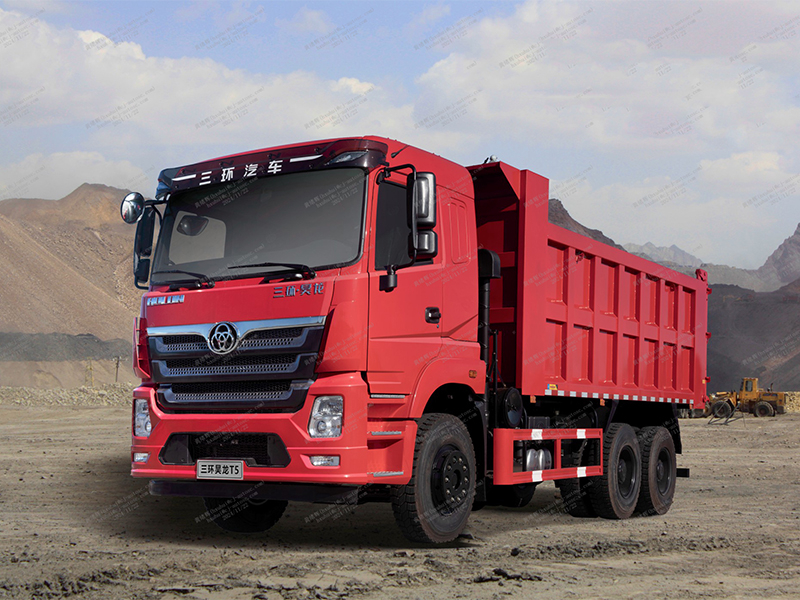
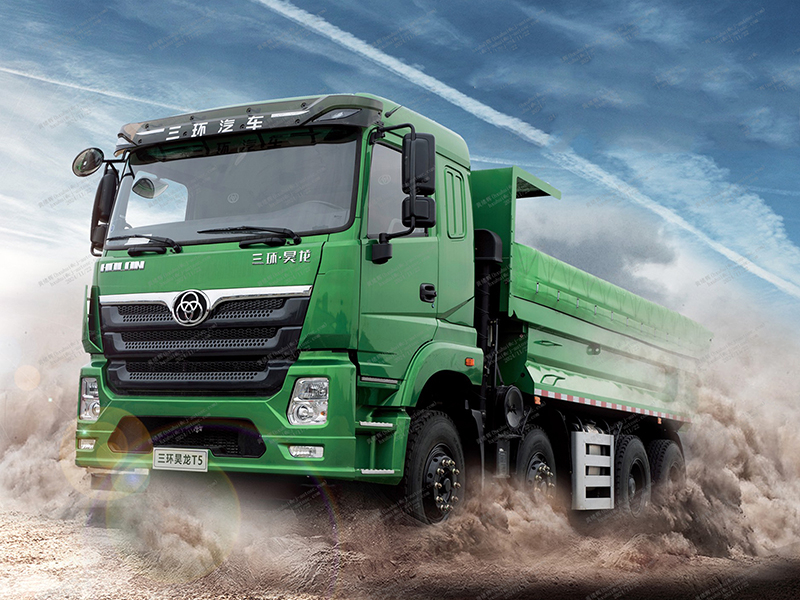
CJ Vehicle lists a T5 6x4 dump truck and a Tri-Ring T5 8x4 heavy-duty truck.
Use those models as a starting point for a specification discussion. Request the final chassis, body, axle ratings and operating weights for the proposed destination and application.
Calculate Usable Payload Before Comparing Body Size
Separate technical ratings from road permission
Gross vehicle weight includes the truck and its load. Payload is the material carried.
A manufacturer’s technical rating does not automatically establish permission to operate at that weight on public roads. Applicable limits can depend on axle loads, axle spacing, suspension, registration, bridges and route restrictions.
Public-road rules also differ between markets. For example, Great Britain’s published limits distinguish three-axle and four-axle rigid vehicles and attach conditions to their higher weight allowances.
Check the destination and route before treating a quoted carrying capacity as legal payload.
Deduct operating tare from the permitted gross weight
Use the truck’s weight in its intended operating condition, including the body, equipment and relevant operating allowances.
The following figures are hypothetical calculation examples. They are not CJ Vehicle specifications or a statement of local law.
Calculation item | Illustrative 6x4 | Illustrative 8x4 |
|---|---|---|
Assumed permitted operating gross weight | 26 t | 32 t |
Assumed operating tare | 12 t | 14 t |
Gross-weight-based payload | 14 t | 18 t |
In this example, the gross-weight-based difference is 4 t per trip. The final load must also satisfy individual axle, tire, chassis, body and tipping-system limits.
A vehicle can remain below its total gross limit while exceeding an axle limit. Confirm load distribution rather than relying only on total weight.
Match body volume to measured bulk density
Body volume and payload are different purchasing quantities.
Material mass equals loaded volume multiplied by bulk density. Moisture, particle size and compaction can change bulk density, so use representative material data.
For example, an assumed bulk density of 1.6 t/m³ produces a 16 t load in 10 m³. That load would exceed the illustrative 14 t payload above even though the body might have additional space.
Do not assign one “ideal body volume” to every sand, gravel or soil application. Specify the material and allowable mass first.
Check Access, Traction and Tipping Conditions
Measure the route instead of assuming a turning circle
A shorter 6x4 specification may be easier to position at a restricted entrance or unloading area. Actual maneuverability still depends on wheelbase, steering geometry, body dimensions and overhang.
Request the turning-circle specification and a swept-path assessment for the proposed truck.
Include the loading area, weighbridge, tightest junction, passing points and discharge position. Confirm the clearance needed when the body is raised as well as during travel.
Evaluate traction separately from axle count
Both configurations have two driven axles. An extra steering axle does not make an 8x4 equivalent to an all-wheel-drive truck.
Traction depends on driven-axle loading, tires, suspension behavior, differential equipment and the road surface. Grade performance also depends on gearing, engine output, gross weight and available grip.
More axles do not automatically mean lower ground pressure in every operating condition. Compare actual loads and tire contact conditions.
For severe mud, sharp crests or highly uneven routes, request application-specific vehicle assessment. Neither layout should be approved solely from a general off-road claim.
Treat tipping stability as a complete-system issue
Neither configuration is inherently safe or unsafe during tipping. Body geometry, load distribution, ground support, slope and material discharge all matter.
Use firm, level tipping areas with sufficient overhead clearance. Keep people clear of the discharge zone.
Sticky or unevenly releasing material requires particular attention. Follow the vehicle and tipping-system instructions; do not drive or jerk the truck to shake a stuck load free.
An extra axle does not compensate for unsuitable tipping ground.
Compare Productivity and Cost per Tonne
Measure complete cycle time
A cycle includes loading, loaded travel, queuing, positioning, unloading and the empty return.
An 8x4’s additional usable payload can improve output, but slower positioning or longer queues may reduce completed trips. A 6x4 may complete more cycles on one route and offer no time advantage on another.
There is no universal distance at which one configuration becomes more economical.
Use observed cycle times or a representative trial to compare the proposed vehicles.
Build a transparent cost model
Daily delivered tonnes equal approved payload multiplied by completed loaded trips.
Cost per tonne equals daily allocated cost divided by delivered tonnes.
The following example uses assumed values only.
Daily comparison | Illustrative 6x4 | Illustrative 8x4 |
|---|---|---|
Approved payload | 14 t | 18 t |
Completed trips | 10 | 9 |
Delivered material | 140 t | 162 t |
Allocated daily cost | US$420 | US$510 |
Cost per delivered tonne | US$3.00 | US$3.15 |
Here, the 8x4 delivers more material but has a higher unit cost. If it completes ten trips at the same daily cost, its unit cost falls to approximately US$2.83/t.
The result depends on utilization and route performance, not payload alone.
Include maintenance and support
Compare fuel consumption under representative loading, tire replacement, scheduled servicing, repairs, downtime and financing.
An additional axle adds service items, but fixed claims about percentage increases require fleet data. Do not assume a universal purchase premium, fuel penalty or tire-cost difference.
Check local access to the specified engine, transmission, brake, suspension and steering parts. Confirm the support arrangements available for the exact truck.
Choose according to the project constraint
Prioritize a 6x4 when it meets the approved payload requirement, fits the access route and delivers the required daily output economically.
Prioritize an 8x4 when additional permitted payload is usable, loading and unloading areas accommodate it, and the productivity gain justifies the complete cost.
Send suppliers the destination, road-use conditions, material, target payload, route distance, gradients and access measurements. Include body requirements, drive position, emissions requirements, quantity and delivery schedule.
Review the CJ Vehicle dump truck range using that application brief before requesting comparable quotations.
Frequently Asked Questions
Does an 8x4 always carry more than a 6x4?
It may offer greater payload potential, but the usable difference depends on permitted gross weight, operating tare and axle distribution. Compare complete vehicles approved for the same destination and route.
Is a 6x4 better in mud?
Not automatically. Both layouts have two driven axles. Tire choice, driven-axle loading, suspension and terrain can outweigh the configuration label. Request a vehicle assessment for severe ground conditions.
Does an 8x4 always cost more per tonne?
No. Its daily cost may be higher while its cost per tonne is lower if additional payload and utilization offset that cost. Calculate both configurations using realistic trips, loading and operating expenses.
Is an 8x4 more likely to overturn while tipping?
Axle count alone cannot establish rollover risk. Assess the complete vehicle, raised-body geometry, load behavior and tipping ground. Both configurations require suitable conditions and correct operating procedures.
What should buyers request before ordering?
Request the final specification, operating tare, gross and axle ratings, body drawings, turning information, tire details and tipping-system information. Confirm destination requirements, documentation, parts support and quotation terms.
To discuss a project-specific comparison, contact CJ Vehicle with your material, payload target, destination and route conditions. Request matched 6x4 and 8x4 proposals so that weight, access and cost can be assessed on the same basis.


