


4x2 vs 6x4 Dump Truck: Which Configuration Fits Your Job?
Views: 0 Author: Site Editor Publish Time: 2026-09-24 Origin: Site


Selecting the wrong dump truck chassis carries heavy operational stakes. Under-speccing your vehicle leads to immediate site immobilization. Trucks sink to the axles in soft mud, and your earthmoving operations halt entirely while you wait for a tow. Conversely, over-speccing drains your daily margins. You burn excess fuel and inflate maintenance schedules for heavy-duty capabilities you never actually use on paved routes. This decision requires a strict balancing act. Fleet managers must weigh payload maximization against site terrain realities, maneuverability constraints, and long-term lifecycle variables.
We designed this technical evaluation framework for fleet managers and owner-operators. You will learn how to objectively compare these configurations based on real-world application data. Making the right choice ensures your fleet operates at peak efficiency, keeping your loaders moving and your materials flowing without unnecessary downtime.
Traction vs. Efficiency: 6x4 configurations provide superior off-road traction and stability for heavy-duty sites, while 4x2 setups offer maximum fuel efficiency for highway and urban routes.
Payload and Compliance: A 6x4 dump truck supports significantly higher Gross Vehicle Weight Ratings (GVWR) and payload capacities, essential for heavy earthmoving and compliance with local axle-weight regulations.
Maneuverability: 4x2 trucks feature a tighter turning radius, making them the default choice for congested urban construction and residential landscaping.
Cost Implications: The initial purchase price and ongoing maintenance costs (tires, driveline) of a 6x4 are higher, requiring consistent heavy-load utilization to justify the ROI over a 4x2.
Table of Contents
Understanding Dump Truck Axle Configurations
Commercial truck terminology relies on a standardized numbering system to identify the total wheel ends and the driven wheel ends. The first number represents the total wheel positions on the ground. The second number indicates how many of those wheel ends receive power from the engine. Understanding this nomenclature is the first step in evaluating your chassis options before you start looking at payload capacities.
How a 4x2 Dump Truck Works
A 4x2 layout represents the most fundamental commercial truck design. It features four total wheel ends, with two of those wheel ends receiving power. The mechanical layout consists of one non-driven front steering axle and one driven rear axle. This setup prioritizes mechanical simplicity and weight reduction over brute pulling force.
This architecture requires significantly fewer driveline components. You only maintain a single rear differential, a shorter driveshaft, and one set of rear suspension components. The absence of a second rear axle drastically reduces the chassis curb weight. A lighter empty weight allows the truck to carry a higher percentage of its own mass as payload. Mechanics appreciate the simplified undercarriage during routine servicing, as there are fewer grease points and brake chambers to inspect.
How a 6x4 Dump Truck Works
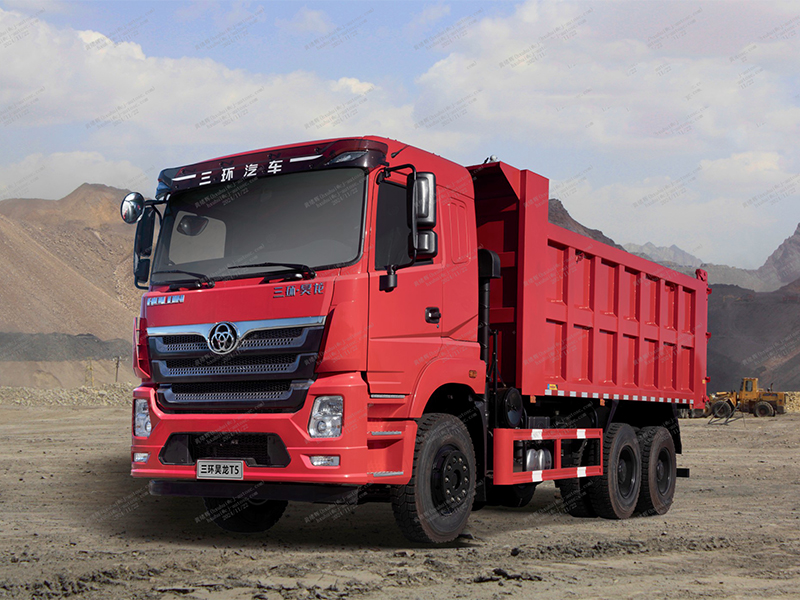
The 6x4 layout dominates heavy construction and earthmoving. It features six total wheel ends, with four of those wheel ends receiving engine power. The mechanical layout includes one non-driven front steering axle and two driven rear axles. This dual rear setup is universally known as a tandem drive.
Power delivery in a 6x4 dump truck involves complex mechanics designed to maximize grip. The driveline utilizes an inter-axle differential and a power divider. These components distribute torque across all four rear wheel ends. If one wheel loses traction in deep mud or loose gravel, the operator can lock the power divider. The system then forces power to the wheels that still have grip. This mechanical advantage prevents slippage and maintains forward momentum in severe off-road conditions where a single axle would simply dig a hole.
Other Dump Truck Configurations: 6x2 and 8x4
The 6x2 dump truck offers a balance between payload capacity and fuel efficiency. It uses two rear axles, but only one axle provides power, making it lighter than a 6x4. However, it has limited traction and is mainly suitable for highway transportation. The 8x4 configuration is designed for extreme heavy-duty applications, with two steering axles and two driven axles. It is commonly used for mining, large-scale construction, and high-volume material hauling where maximum payload capacity is required.
4x2 vs 6x4 Dump Truck: Core Performance Dimensions
Evaluating a 4x2 vs 6x4 dump truck requires analyzing specific performance metrics on the ground. Each chassis excels in different operational environments. You must align these mechanical capabilities with your daily job site realities to avoid operational bottlenecks.
Payload Capacity and Load Distribution
A 6x4 dump truck is designed for heavier loads with two rear axles that distribute weight more evenly and support larger dump bodies. It performs well when hauling dense materials such as gravel, wet soil, and concrete debris. A 4x2 truck has a lighter structure and better payload efficiency but reaches its weight limit faster when carrying heavy materials.
Off-Road Traction and Terrain Performance
A 6x4 dump truck provides stronger traction for challenging environments such as mud, snow, sand, and construction sites. Its dual drive axles improve pulling power and stability under heavy loads. A 4x2 works well on paved roads and firm surfaces but may struggle in loose or slippery conditions.
Turning Radius and Driving Flexibility
A 4x2 dump truck offers better maneuverability because of its shorter wheelbase and simpler rear axle design. It is suitable for urban areas, narrow roads, and tight job sites. A 6x4 requires more space for turning, and frequent sharp turns can increase tire wear due to rear axle movement.
Fuel Efficiency and Operating Costs
A 4x2 dump truck usually provides better fuel efficiency because it has fewer drivetrain components, lower weight, and less rolling resistance. A 6x4 consumes more fuel due to its additional axle, heavier structure, and higher mechanical load. However, the extra operating cost can be justified when higher payload capacity and off-road performance are required.
When to Choose a 4x2 Dump Truck
Matching the chassis to the job profile prevents operational mismatches. The 4x2 excels in specific, well-defined environments. It is a precision tool for lighter hauling and tight access.
Best Applications for 4x2 Dump Trucks
Certain industries rely heavily on the agility of a single-axle truck. These operations prioritize speed, site access, and fuel economy over massive payloads.
Municipal road maintenance and asphalt patching crews.
Light-to-medium residential landscaping projects hauling mulch or topsoil.
Urban material delivery, dropping sand and gravel in tight driveways.
Highway-centric hauling where cargo density remains low.
Site cleanup operations in narrow residential neighborhoods.
When to Deploy a 6x4 Dump Truck
Heavy industry requires brute force and maximum capacity. The 6x4 provides the structural integrity and traction needed for severe duty cycles. It is the undisputed backbone of commercial earthmoving.
Ideal Operational Profiles
Operations that move massive volumes of dense material depend on tandem drive axles. These jobs occur in environments where roads are temporary, uncompacted, or nonexistent.
Heavy commercial construction and initial site preparation.
Mining support and quarry aggregate hauling.
Large-scale earthmoving and deep excavation projects.
Forestry and logging road construction.
Short-distance transport of dense, wet materials like clay and slurry.
Why the 6x4 Dump Truck Dominates Heavy Industry
Tandem drives are mandatory for maintaining momentum in poor conditions. When pulling fully loaded boxes out of unpaved pits, a single axle simply digs a hole. Four driven wheels claw through loose terrain. They distribute the torque evenly to prevent wheel spin and keep the load moving forward.
Stability presents another major advantage. Raising a loaded dump bed shifts the center of gravity dramatically. Doing this on uneven terrain is dangerous and risks tipping the truck. The wider footprint and dual axles of a 6x4 provide a highly stable platform. This prevents rollovers during the dumping process on rugged, unlevel sites.
Maintenance and Legal Requirements
Evaluating the long-term viability of your chassis choice requires looking at maintenance realities and legal weight limits. You must analyze how much time the truck will spend in the shop versus on the road. Regulatory compliance also dictates exactly what you can haul and where you can haul it.
Maintenance Differences Between 4x2 and 6x4
A 6x4 dump truck has more complex components, including an additional drive axle, suspension parts, and drivetrain systems, which require more maintenance. It also uses more tires and may experience faster tire wear during frequent tight turns on paved roads. A 4x2 has a simpler structure, making it easier and cheaper to maintain for urban and highway operations.
Axle Weight Limits and Road Regulations
Truck configuration must meet local weight regulations and road requirements. A 6x4 dump truck distributes heavy loads across multiple axles, allowing it to carry larger payloads while meeting axle weight limits. Choosing the correct configuration helps avoid overweight penalties, compliance issues, and unnecessary operational risks.
How to Choose the Right Dump Truck Configuration
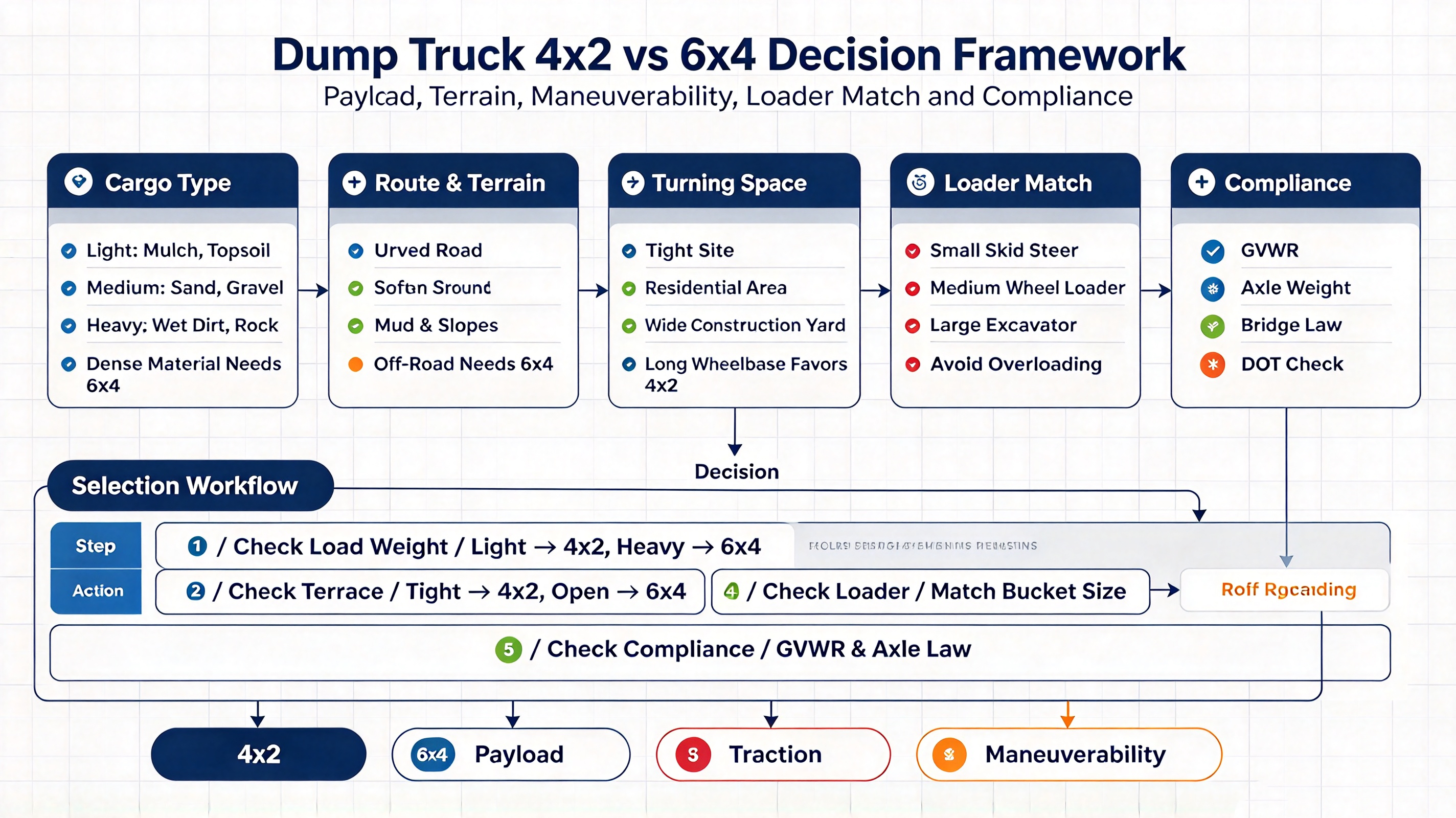
Choosing the right truck requires a systematic audit of your operations. You must evaluate what you haul, where you haul it, and how you load it. Use this framework to guide your procurement strategy.
Choosing Based on Cargo Weight
The type and weight of materials determine the right dump truck configuration. Heavy materials such as wet soil, concrete debris, and rocks usually require a 6x4 dump truck for better load support. Lighter materials like mulch, dry soil, and landscaping materials can be handled efficiently by a 4x2 truck.
Choosing Based on Road and Job Site Conditions
Job site conditions directly affect truck selection. Consider how much time the truck spends on highways or off-road areas, the slope of work sites, weather conditions, and available turning space. A proper evaluation helps ensure the truck matches the actual working environment.
Matching Dump Trucks with Loading Equipment
The dump truck should work efficiently with existing loaders and excavators. Matching the dump body size with loader capacity prevents overloading, unnecessary loading cycles, and equipment damage. A balanced combination improves productivity, reduces fuel waste, and keeps the entire operation running smoothly.
Operational Comparison: 4x2 vs 6x4 Configurations | ||
Feature/Metric | 4x2 Configuration | 6x4 Configuration |
|---|---|---|
Driven Wheels | 2 (Single Rear Axle) | 4 (Tandem Rear Axle) |
Primary Environment | Urban, Paved, Residential | Off-road, Construction, Mining |
Maneuverability | Excellent (Tight turning radius) | Poor (Tandem scrub on tight turns) |
Payload Capacity | Light to Medium | Heavy to Extreme |
Fuel Efficiency | High (Lower rolling resistance) | Low (Higher parasitic drag) |
Traction | Adequate for dry/paved surfaces | Superior in mud, snow, and steep grades |
Conclusion
Neither configuration is universally superior. The choice is strictly dictated by the operational environment, cargo weight, and payload requirements. Buying the wrong chassis forces your operators to fight the equipment daily. Buying the right chassis streamlines your entire logistics chain and keeps materials moving efficiently.
Follow a strict shortlisting logic. Choose a 4x2 for urban agility, paved routes, and maximum fuel economy on lighter loads. Choose a 6x4 for maximum payload, off-road traction, and heavy-duty site resilience.
Take these immediate next steps to finalize your procurement process:
Audit your three most frequent job sites to determine actual off-road traction requirements.
Calculate your average required payload per trip based on historical hauling data and material density.
Consult with a commercial truck dealer to spec the exact horsepower, gear ratios, and suspension type.
Review local bridge laws to ensure your chosen configuration meets weight compliance for your specific routes.
FAQ
Q: What is the main difference between a 4x2 and a 6x4 dump truck?
A: The primary difference lies in the wheel ends and driven axles. A 4x2 has four total wheel ends with two driven wheels on a single rear axle. A 6x4 has six total wheel ends with four driven wheels across a tandem rear axle setup.
Q: Can a 4x2 dump truck operate off-road?
A: Yes, but with strict limitations. It handles hard-packed dirt and dry, level ground well. However, it risks getting stuck in mud, deep sand, or loose gravel due to limited traction from its single drive axle.
Q: Should I consider a 6x2 dump truck instead of a 6x4?
A: A 6x2 offers the payload capacity of a three-axle truck with better fuel economy than a 6x4. It uses a dead tag axle instead of a second drive axle. However, it lacks the necessary traction for heavy off-road work.
Q: Which configuration is better for highway driving?
A: The 4x2 is generally better for dedicated highway driving. It features lower rolling resistance, fewer moving driveline parts, and a lighter curb weight. This results in significantly better fuel efficiency at highway speeds.
Q: How does a tandem axle affect turning radius?
A: Tandem axles widen the turning radius. During sharp turns, the two rear axles fight each other, causing the tires to drag sideways across the ground. This phenomenon, called tandem scrub, makes tight maneuvers difficult.
Q: Does a 6x4 require more maintenance than a 4x2?
A: Yes. A 6x4 has an additional drive axle, an inter-axle differential, extra suspension components, and four more tires. This mechanical complexity requires more time for routine servicing, lubrication, and tire replacement.


