


8x4 Dump Truck: When Do You Need a Heavy-Duty Tipper?
Views: 0 Author: Site Editor Publish Time: 2026-09-24 Origin: Site


Procuring heavy-duty fleet vehicles requires massive capital expenditure. Selecting the wrong truck configuration immediately creates operational bottlenecks that cripple site productivity. Fleet managers constantly face the core business problem of balancing maximum payload capacity and larger body volume against terrain limitations, maneuverability constraints, and strict per-axle load regulations. Upgrading to a heavier multi-axle vehicle means matching mechanical capabilities with specific site realities. You must ensure the vehicle can legally navigate public roads while surviving the brutal conditions of active construction sites. This technical evaluation framework helps you determine if an 8x4 dump truck aligns with your project demands, site constraints, and regulatory requirements.
Payload vs. Maneuverability: An 8x4 dump truck maximizes payload and heavy-load stability but sacrifices the tighter turning radius found in 6x4 configurations.
Regulatory Compliance: The four-axle design is critical for legally distributing heavier gross vehicle weights across unstable road surfaces and public highways without exceeding per-axle limits.
Optimal Use Cases: Best suited for high-volume, short-distance hauling (e.g., large-scale construction, demolition waste, coal materials, and aggregate transport) where route conditions are relatively predictable.
Powertrain Considerations: The increased upfront cost, higher engine horsepower requirements, and maintenance of dual steering axles must be offset by the reduction in total trips required to move material.
Table of Contents
What Is an 8x4 Dump Truck?
8x4 Dump Truck Axle Design Explained
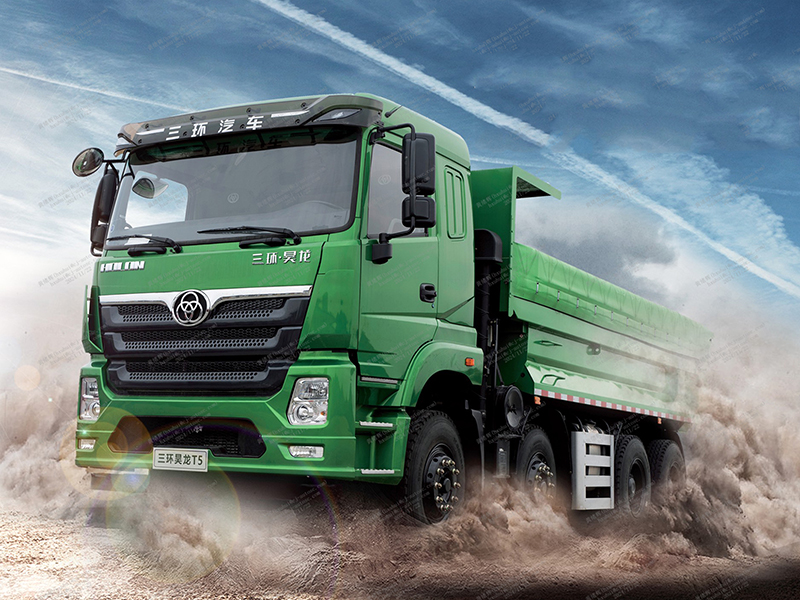
The "8x4" nomenclature refers directly to the wheel-end and drivetrain layout of the chassis. The vehicle features eight wheel ends in total. Four of these wheel ends receive power from the engine. This configuration utilizes dual front steering axles and dual rear drive axles. The mechanical function of the dual front steering axles is to bear the immense weight of the large displacement engine, the reinforced cab, and the forward section of the loaded cargo box. The dual rear drive axles provide the necessary traction and pushing power to move the heavy chassis through challenging environments.
This multi-axle configuration distributes heavy loads over a larger surface area. It significantly reduces per-axle stress on infrastructure. When running near maximum capacity on unstable road surfaces, a three-axle truck concentrates weight intensely on its rear tandem, often causing rutting. The addition of the second steering axle on an 8x4 dump truck shifts a portion of the payload forward. This weight distribution prevents the rear wheels from sinking into soft ground. It also ensures the vehicle complies with highway bridge formulas that dictate maximum allowable weight per axle, keeping your fleet legally compliant on public roads.

Engine and Transmission Options
Heavy-duty tippers require powerful engines and transmissions to handle large payloads. High torque at low RPM helps the truck move smoothly under heavy loads, while low-speed gears improve climbing ability on steep roads. Differential locks and strong drive axles provide better traction on mud, gravel, and difficult terrain.
Dump Body and Hydraulic System Guide
The dump body design should match the type of material being transported. U-shaped bodies work well for sticky materials like soil and clay, while square bodies provide more volume for bulky materials. Wear-resistant steel improves durability when hauling rocks and aggregates. A strong hydraulic system ensures safe and stable dumping of heavy loads.
Choosing the Right Dump Body and Hydraulic Setup
Selecting the correct body material and lifting system improves productivity and reduces maintenance costs. Heavy-duty steel protects against impact damage, while reliable hydraulic components support repeated lifting cycles. The right configuration helps the truck handle demanding construction and mining applications efficiently.
Tipper Body Type | Ideal Material Application | Structural Advantage | Unloading Characteristics |
|---|---|---|---|
U-Shaped Body | Wet soil, clay, asphalt, fine aggregate | Lighter tare weight, highly rigid structure | Smooth material flow, minimal corner residue |
Square Body | Demolition waste, riprap, coal, bulky scrap | Maximum cubic volume, flat floor for heavy impacts | Requires higher dump angle to clear flat corners |
6x4 vs. 8x4 Dump Truck: Core Technical Trade-Offs
Payload Capacity and Volume Metrics
An 8x4 dump truck offers higher payload capacity than a 6x4 model, allowing more material to be moved per trip. However, the correct dump body size depends on material density. Lightweight materials can use larger bodies, while heavy materials require smaller boxes to avoid overloading the chassis, tires, and hydraulic system.
Heavy-Load Stability on Unstable Surfaces
The four-axle design improves stability when carrying and unloading heavy materials. The longer wheelbase provides a larger support area, reducing rollover risks during dumping. However, 8x4 trucks perform best on compacted roads and stable sites, while deep mud may require specialized off-road vehicles.
Maneuverability and Turning Radius Constraints
The larger size of an 8x4 dump truck reduces maneuverability compared with smaller configurations. The longer wheelbase requires more turning space and careful route planning. Before purchasing, evaluate loading areas, dumping zones, and site access to ensure the truck can operate efficiently without causing delays.
Best Applications for 8x4 Dump Trucks
Construction and Demolition Applications
Mass excavation and demolition projects demand high-volume material removal. Moving concrete rubble, twisted rebar, excavated soil, and general demolition waste requires durable equipment. The efficiency gains of moving these materials in fewer trips are undeniable. A fleet of four-axle tippers clears a demolition site much faster than smaller trucks. This keeps 30-ton and 40-ton excavators continuously working and prevents site congestion. Square bodies reinforced with impact-resistant steel handle the jagged edges of broken concrete without structural failure.
Mining, Quarrying, and Aggregate Transport
Aggregate production relies on continuous material flow. You must transport sand, gravel, and crushed stone from the active pit face to the processing plant. Four-axle trucks bridge the gap between off-road articulated haulers and highway-legal transport. They carry massive payloads of raw stone over maintained quarry haul roads. Once the stone is crushed and graded, these same trucks transport the finished aggregate to concrete batch plants or highway construction sites. Their ability to carry maximum legal weight on public roads makes them indispensable for aggregate logistics.
Bulk Material Transportation
The energy sector frequently transports low-density, high-volume bulk goods. Coal materials, wood chips, and biomass require massive cargo boxes to achieve efficient payload weights. High-volume square bodies are specifically designed for this application. An 8x4 dump truck provides the necessary chassis length to support these elongated bodies. The dual steering axles safely support the extended front overhang of the cargo box. This configuration maximizes throughput for power plants and bulk material transfer stations.
Short-Distance, High-Volume Hauling
The ideal route profile involves short-to-medium distance runs where maximum throughput is required. Plant-to-site runs are the perfect example. Supplying a major highway paving project with asphalt or aggregate requires constant, heavy deliveries. These routes often utilize public highways where strict weight limits apply. The four-axle configuration allows operators to maximize the payload per trip while remaining legally compliant. Long-distance hauling is generally reserved for tractor-trailers, but for regional, high-frequency heavy hauling, the rigid four-axle tipper is superior.
How to Choose the Right 8x4 Dump Truck
Check Your Working Conditions Before Buying
Before choosing a heavy-duty tipper, evaluate your job site conditions carefully. Check road slopes, ground strength, loading and dumping areas, turning space, and overhead clearance. The truck must match your terrain, equipment size, and daily operation requirements to ensure safe and efficient performance.
Weight Regulations and Legal Requirements
Axle limits and road regulations directly affect dump truck selection. An 8x4 configuration helps distribute heavy loads across more axles, reducing pressure on each axle and improving legal payload capacity. Choosing the correct axle setup helps avoid overweight fines, road restrictions, and unnecessary operating risks.
Conclusion
Take the following steps to finalize your procurement strategy:
Calculate your exact route payload requirements based on local highway axle weight limits and bridge formulas.
Measure your site's loading zones, dumping areas, and tightest switchbacks to confirm spatial clearance for the extended wheelbase.
Match the engine displacement and cargo box volume directly to the specific gravity of the materials you intend to haul.
Audit your maintenance facility to ensure your mechanics have the equipment to align dual steering axles.
Request an on-site demonstration to observe how the vehicle handles your specific haul roads under full load.
FAQ
Q: What is the average payload capacity of an 8x4 dump truck?
A: Payload capacity typically ranges from 20 to 35 metric tons, depending on the chassis weight and regional highway regulations. Gross vehicle weight often reaches 40 to 50 tons. Exact figures depend heavily on the cargo body type, material density, and local per-axle weight limits.
Q: What does "8x4" actually mean on a heavy-duty tipper?
A: The "8x4" designation refers to the wheel-end and drivetrain configuration. The truck has 8 wheel positions on the ground. Exactly 4 of those wheel positions receive power from the engine, which is delivered exclusively through the dual rear drive axles.
Q: How does an 8x4 compare to a 6x4 dump truck in off-road conditions?
A: While 8x4s carry more weight and offer superior heavy-load stability during dumping, 6x4s generally have better traction in deep mud. The two front steering axles on an 8x4 can create rolling resistance in soft, uncompacted soil, making them better suited for graded haul roads.
Q: Are 8x4 dump trucks suitable for long-distance hauling?
A: They are typically optimized for short-to-medium distance heavy hauling, such as plant-to-site runs or quarry logistics. Long-distance bulk transport is usually better served by articulated tractor-trailers, which offer better fuel efficiency for highway cruising.
Q: What type of tipper body is best for an 8x4 truck?
A: U-shaped bodies built with wear-resistant steel are best for cohesive materials like wet soil and clay, as they prevent sticking. Square bodies maximize internal volume and are ideal for transporting bulky demolition waste, large rocks, and low-density coal materials.
Q: How do axle load regulations impact 8x4 dump truck operations?
A: Highway regulations strictly limit the weight placed on a single axle to prevent road damage. The extra steering axle allows operators to legally distribute heavier gross vehicle weights across the pavement, maximizing payload per trip without triggering overweight fines.


