


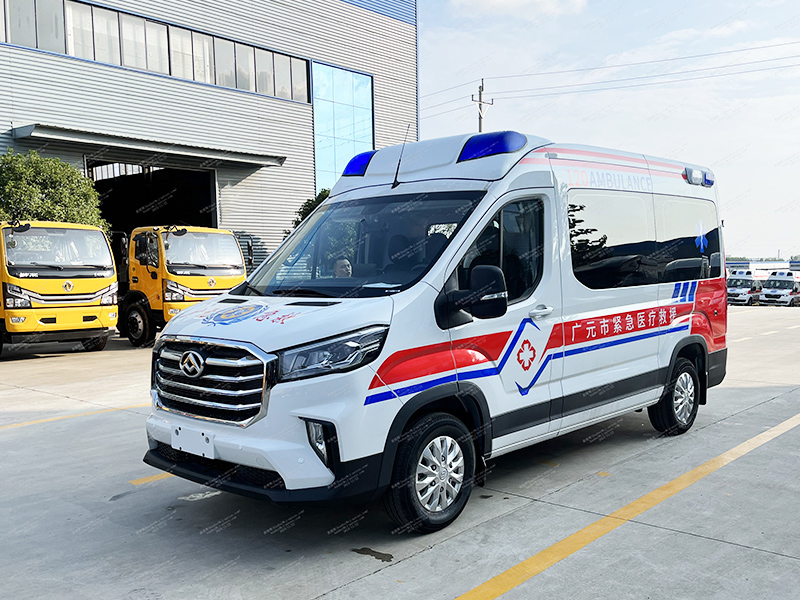


SAIC Datong V90 long-axis high-roof monitoring ambulance — purpose-built for inter-hospital patient transfer, urban EMS, and frontline critical care transport.
Product Overview
The Datong V90 Ambulance Vehicle from CJQC is a long-axis, high-roof monitoring ambulance engineered for hospitals, emergency centers, and patient-transfer fleets that need both clinical capability and rapid response in dense urban traffic.
Chassis: SAIC Datong V90 long-axis, high-roof, manual-transmission diesel platform, China VI
Body dimensions: 5,498 mm × 2,062 mm × 2,600 mm
Medical cabin: 2,700 mm × 1,700 mm × 1,750 mm
Wheelbase: 3,366 mm
Gross vehicle weight: 3,550 kg
Seating: 7 occupants (driver, attendant, family member, and stretcher patient)
Engine: SC20M150.1Q6 turbo-diesel, 1.996 L, 110 kW rated, China VI
Top speed: 160 km/h
Drive: Front-engine, front-wheel drive (4×2)
Fuel tank: 80 L
Minimum ground clearance: 150 mm
Approach / departure angle: 19° / 18°
Safety: ADAS driver assistance, Bosch 9.3 ESP, LDW lane-departure warning, 50% ultra-high-strength steel
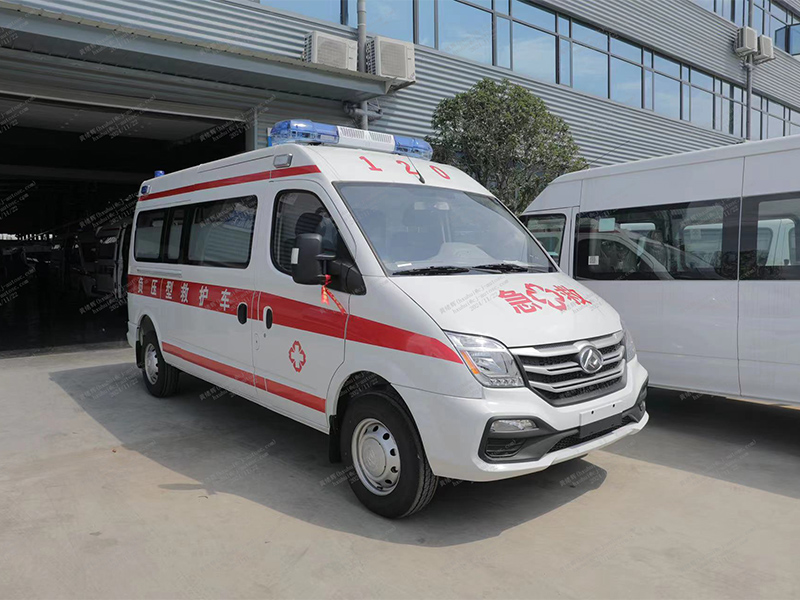
Exterior: White body, Red Cross emblems, 100 W LED warning light bar, side and rear blue strobes
Medical fit-out: 1,000 W pure-sine inverter, 2 × 10 L oxygen cylinders @ 15 MPa, UV timed disinfection lamp, automatic loading stretcher
Product Description
The Datong V90 Ambulance transforms SAIC’s proven long-wheelbase, high-roof platform into a nimble, city-ready EMS asset. CJQC’s dedicated medical conversion integrates a fully sealed oxygen system, a 1,000W pure sine-wave inverter, and a logically zoned clinical interior designed by active paramedics.
Power comes from the SC20M150.1Q6 2.0L bi-turbo diesel, delivering 110 kW and a flat torque curve that ensures crisp acceleration through urban intersections while maintaining a 160 km/h cruising capability. Paired with a 6-speed gearbox, it keeps the engine in its optimal torque band on rolling terrain.
Inside, the 2,700 mm medical bay features a curbside clinician corridor, centrally mounted stretcher, and head-wall equipment mounting within arm’s reach. Lightweight, antimicrobial panels and slip-resistant flooring ensure rapid decontamination, while the tinted privacy partition maintains patient dignity.
Built on a 50% ultra-high-strength steel body with Bosch 9.3 ESP and optional ADAS, the V90 offers exceptional road manners. For evolving public health needs, the chassis supports a factory-option negative-pressure module (-30 to -10 Pa) without compromising the original layout.

Features and Highlights
Clinical-Grade Medical Cabin
2,700 mm × 1,700 mm × 1,750 mm working envelope — tall enough for an adult to stand upright and work over a stretcher
Antimicrobial FRP interior panels, anti-slip medical-grade vinyl floor, sealed seams for easy disinfection
Privacy partition with sliding observation window between cab and cabin
Right-side sliding door for patient loading, rear double doors for full-width access and stretcher trolley entry
Power System and Oxygen Delivery
1,000 W pure-sine-wave inverter for monitors, ventilators, infusion pumps, and suction units
Dual 220 V and 12 V multi-function outlets (universal 2-pin + 3-pin, AC and DC)
2 × 10 L medical oxygen cylinders at 15 MPa working pressure — up to 8 hours of continuous patient oxygen
Dual single-gauge pressure regulators, German-style quick-connect oxygen terminals, ventilator interface port, and wall-mounted humidifier bottle
Stretcher and Patient Handling
Automatic loading stretcher: high-strength aluminum alloy frame, PVC waterproof foam mattress, adjustable backrest, reinforced oval leg tubes, side-mounted loading wheels
Stretcher platform in aluminum alloy for secondary loading or stair-chair transfer
Ceiling-mounted IV rail with two folding hooks
Driver-Focused Safety Stack
ADAS driver assistance with active road-condition analysis
Bosch 9.3 ESP body-stability system with integrated ABS, EBD, and traction control
LDW lane-departure warning that gently corrects direction on highway runs
50% ultra-high-strength steel in the body shell (industry average ~30%)
Low center of gravity for reduced body roll in emergency cornering
Disinfection and Air Quality
Intelligent timed UV disinfection lamp — set-and-forget cycle, automatic shutoff for crew safety
Rear cabin air-conditioning and rear cabin heater, independent front/rear temperature control
DC 12 V bidirectional ventilation fan in the roof for continuous cabin air exchange
Vehicle Dimensions and Chassis
The long-axis, high-roof body gives the Datong V90 Ambulance Vehicle a class-leading interior envelope without making the vehicle too long for tight hospital loading bays or narrow residential streets. The 3,366 mm wheelbase, combined with 19° / 18° approach and departure angles, lets the vehicle handle speed-bumps, curb cuts, and shallow ramps that stop shorter-wheelbase vans.
Chassis and Body Specifications
Parameter | Value |
|---|---|
Drive configuration | Front-engine, front-wheel drive (4×2) |
Overall length × width × height | 5,498 mm × 2,062 mm × 2,600 mm |
Medical cabin (L × W × H) | 2,700 mm × 1,700 mm × 1,750 mm |
Wheelbase | 3,366 mm |
Approach angle / Departure angle | 19° / 18° |
Minimum ground clearance | 150 mm |
Gross vehicle weight (GVW) | 3,550 kg |
Seating capacity | 7 (driver + attendants + stretcher patient) |
Top speed | 160 km/h |
Fuel tank capacity | 80 L |
Body color | White with Red Cross emblems and reflective side bands |
Suspension, Brakes, Steering, and Tires
System | Specification |
|---|---|
Front suspension | MacPherson independent suspension |
Rear suspension | Non-independent, 2-leaf spring |
Brakes | Front and rear disc, hydraulic |
Steering | Rack-and-pinion with hydraulic power assistance |
Tires | 215/75 R16 LT, all-season commercial |
Transmission | 6 forward gears + 1 reverse, manual |
Engine and Drivetrain
The SC20M150.1Q6 is a 1.996 L four-cylinder turbo-diesel designed and produced by SAIC for commercial-vehicle duty. Its dual-shaft balance system, dual independent cooling loops, variable-displacement oil pump, and variable-swirl intake keep fuel consumption low and NVH controlled — both important when clinicians are working over a patient at the back of a moving vehicle. The 110 kW rated power, paired with the six-speed manual transmission, gives the V90 ambulance a usable speed range from 0–160 km/h without an over-rev penalty, and the diesel torque curve makes light work of fully-loaded patient-transfer runs in hilly cities.
Powertrain Specifications
Parameter | Value |
|---|---|
Engine model | SC20M150.1Q6 |
Engine type | Four-cylinder, 16-valve, dual overhead camshaft, turbo-diesel |
Displacement | 1.996 L |
Rated power | 110 kW |
Emission standard | China VI (Euro 6-equivalent) |
Fuel type | Diesel (EN 590 / China-VI diesel) |
Transmission | 6-speed manual, synchromesh, cable shift |
Driveline | Front-engine, front-wheel drive (4×2) |
Maximum speed | 160 km/h |
Medical Cabin Configuration
The cabin is designed around the way EMS crews actually work: approach the patient from the curb, monitor from the head, work from the head and from the side wall, and exit rearward. Everything in the cabin is fixed, sealed, and easy to wipe down.
Fixed Cabinetry
Partition wall: FRP composite with a sliding glass observation window, sealed against noise and dust
Equipment cabinet (long): FRP composite with multiple drawers and open-shelf bays for monitors, suction units, and consumables
Oxygen cylinder cabinet: dedicated enclosure for 2 × 10 L cylinders, with quick-release straps and a sealed drain
Overhead cabinet: top-hinged lift-up doors for lightweight consumables and airway kits
Long bench seat: with cushion, backrest, and two-point seatbelts for one attendant and a family member
Stretcher and Patient Handling
Automatic loading stretcher (aluminum alloy, PVC waterproof mattress, adjustable backrest, reinforced oval leg tubes, side loading wheels)
Aluminum alloy stretcher platform for secondary patient transfer
Ceiling-mounted IV rail with two folding hooks
Interior Surface Treatment
Antimicrobial FRP panels for wall and ceiling — waterproof, mildew-resistant, and easy to disinfect
Medical-grade anti-slip vinyl flooring, seam-welded for liquid containment
Frosted film on cabin glass to protect patient privacy
Optional Cabin Modules
Negative-pressure isolation enclosure (-30 Pa to -10 Pa) for infectious-disease transport
Scoop stretcher
Stair-climb stretcher (160 kg load rating)
Side-door step board for curb-side access
Electrical and Oxygen Systems
The medical electrical system is sized for full-shift use of a patient monitor, a portable ventilator, a suction unit, and an infusion pump — all running from the cabin's dedicated 12 V DC bus and 220 V AC bus without taxing the chassis electrical system.
Power Conversion and Outlets
1,000 W pure-sine-wave inverter for clean AC power to sensitive medical devices
Stable output frequency and voltage across the full engine RPM range
Two groups of 220 V and 12 V multi-function outlets (2-pin and 3-pin, AC and DC) on the equipment wall
Cabin Lighting
Four 12 V interior ceiling lights with stable output and wide coverage
Two dedicated procedure lamps for IV-line work and airway management
Oxygen System
2 × 10 L medical oxygen cylinders at 15 MPa nominal pressure (lightweight, easy to swap)
2 × single-gauge pressure regulators
2 × German-style quick-connect oxygen terminals at the head of the stretcher
1 × ventilator interface port
1 × wall-mounted oxygen humidifier bottle
Disinfection
1 × intelligent timed UV disinfection lamp — automated cycle, automatic shutoff when the cabin is opened
Safety and Driver Assistance
EMS vehicles are safety-critical: they run at speed, in heavy traffic, often with sirens and lights. The Datong V90 Ambulance Vehicle is engineered to give the driver every possible margin.
Body shell: Integrated load-bearing monocoque with a European-style safety crash design; 50% of the body-in-white is ultra-high-strength steel (industry average ~30%)
Lower center of gravity: Reduces body roll in emergency cornering and on curved highway ramps
ADAS driver assistance: Continuously analyzes road conditions and adjusts following distance and warning thresholds
LDW lane-departure warning: Detects lane drift and gently corrects direction — especially valuable on long inter-hospital transfers
Bosch 9.3 ESP: Body-stability program that integrates ABS, EBD, and traction control to keep the vehicle composed under braking on wet roads
Front and rear disc brakes: Linear, fade-resistant stopping power at 160 km/h
Long wheelbase (3,366 mm): Stable at highway speed; 19° / 18° approach and departure angles for uneven road surfaces
Exterior and Warning Systems
The exterior is finished in a globally familiar EMS livery: white body, Red Cross emblems on the hood, flanks, and rear, and a colorful reflective band on all four sides for high visibility in low light.
Body structure: Reinforced steel frame, monocoque-integrated for rigidity and crash performance
Right-side sliding door: for fast patient loading in tight parking situations
Rear double doors: Wide-opening for stretcher trolleys and bariatric transfer
Red Cross markings: Front, both flanks, and rear doors
Reflective band: Four-side colored reflective tape
Privacy glazing: Cabin glass finished with frosted film to protect patient dignity
Warning light bar: Streamlined, split-embedded LED bar in polymer housing, 100 W siren amplifier, cab-mounted line controller, integrated LED light array
Auxiliary strobes: Blue flashing lights on both flanks and at the rear for use in mixed traffic
Typical Applications
The Datong V90 Ambulance Vehicle is engineered to serve a wide range of patient-handling scenarios, from primary emergency response to inter-hospital transfer and infectious-disease transport. Its 2,700 mm medical cabin, long wheelbase, and 7-seat configuration make it a flexible platform for both public EMS fleets and private operators.
Hospital-based EMS: Primary response vehicle for city hospitals, capable of advanced monitoring en route — IV line management, continuous oxygen, and full vital-sign monitoring are all supported from the standard cabin fit-out
Inter-hospital patient transfer: Long-distance transfer of stable and semi-critical patients between facilities; the 80 L fuel tank and 160 km/h top speed keep transit times short on highway runs
Private patient transport: For operators serving insurance, repatriation, and private-clinic transfers where a clinical cabin, not just a stretcher, is required
Event medical standby: Concerts, sports events, large public gatherings, and political summits — the cabin supports on-scene treatment of multiple patients
Industrial and mining medical response: On-site first response for remote work sites in mining, oil & gas, and large construction projects
Public-health and infectious-disease response: With the optional negative-pressure module, the same platform handles confirmed-case transport with sealed cabin and HEPA-grade exhaust
Disaster and mass-casualty support: Command and triage vehicle at the scene of multi-patient incidents; the rear double doors and right-side sliding door allow simultaneous patient intake and clinician exit
Cross-border and repatriation transfers: Long-haul inter-city and cross-border patient transport with the SC20M150 diesel range and the comfort of a high-roof cabin
Product Parameters (Full Specifications)
Complete Datong V90 Ambulance Vehicle Specification Sheet
Category | Parameter | Value |
|---|---|---|
Chassis & Body | Drive configuration | 4×2 (front-engine, front-wheel drive) |
Chassis | SAIC Datong V90 long-axis, high-roof, China VI diesel | |
Body color | White with Red Cross emblems and four-side reflective band | |
Overall dimensions (L × W × H) | 5,498 mm × 2,062 mm × 2,600 mm | |
Medical cabin (L × W × H) | 2,700 mm × 1,700 mm × 1,750 mm | |
Wheelbase | 3,366 mm | |
Approach / departure angle | 19° / 18° | |
Minimum ground clearance | 150 mm | |
Gross vehicle weight | 3,550 kg | |
Seating | 7 persons (driver + attendants + stretcher patient) | |
Top speed | 160 km/h | |
Engine & Drivetrain | Engine model | SC20M150.1Q6 |
Engine type | Four-cylinder, 16-valve, DOHC, turbo-diesel | |
Displacement | 1.996 L | |
Rated power | 110 kW | |
Emission standard | China VI | |
Fuel type | Diesel | |
Fuel tank | 80 L | |
Transmission | 6 forward + 1 reverse, manual | |
Driveline | Front-engine, front-wheel drive | |
Chassis Systems | Front suspension | MacPherson independent |
Rear suspension | Non-independent, 2-leaf spring | |
Brakes | Front and rear disc, hydraulic | |
Steering | Rack-and-pinion, hydraulic power assist | |
Tires | 215/75 R16 LT | |
Medical Cabin | Interior | Antimicrobial FRP panels, anti-slip medical vinyl floor |
Fixed furniture | Equipment cabinet, oxygen cabinet, overhead cabinet, bench seat, partition with observation window | |
Stretcher | Automatic loading stretcher (aluminum alloy, PVC mattress, adjustable backrest) | |
Electrical & Oxygen | Inverter | 1,000 W pure sine wave |
Outlets | 2 × 220 V / 12 V multi-function, 2-pin and 3-pin | |
Cabin lighting | 4 × 12 V ceiling lights + 2 procedure lamps | |
Oxygen system | 2 × 10 L cylinders @ 15 MPa, 2 × regulators, 2 × German quick-connect terminals, ventilator port, humidifier | |
Disinfection | UV lamp | 1 × intelligent timed UV disinfection lamp |
Air System | HVAC & Ventilation | Rear cabin A/C + heater, independent front/rear control; 1 × DC 12 V bidirectional roof fan |
Safety | Driver assistance | ADAS, LDW, Bosch 9.3 ESP |
Body | Integrated monocoque, 50% ultra-high-strength steel | |
Exterior | Doors | Right-side sliding door, rear double doors |
Warning lights | 100 W LED light bar with siren, side and rear blue strobes |
Packaging and Delivery
Each vehicle is finished, signed off on a 200-item quality checklist, and prepared for export at the CJQC facility.
Packaging: Naked or wax-film protective wrap; reinforced wooden frame for LCL or FCL sea-freight; roll-on / roll-off option for finished vehicles
Lead time: 25–35 working days for the standard monitoring configuration; 40–60 working days when the negative-pressure isolation module is added
Port of loading: Shanghai, Ningbo, or Wuhan (rail-linked to most major inland markets)
Incoterms supported: EXW, FOB, CFR, CIF, DAP, DDP
Documentation: Commercial invoice, packing list, certificate of origin, CCC certificate, ISO certificates, bill of lading, and (on request) embassy legalization and pre-shipment inspection report
Why Choose CJQC
Built on a proven EMS platform. The SAIC Datong V90 long-axis, high-roof is one of the most widely deployed EMS chassis in Asia — parts are local, technicians are trained, and resale value is strong.
Safety as a primary specification. 50% ultra-high-strength steel, Bosch 9.3 ESP, ADAS, and LDW are not optional extras — they ship on every Datong V90 Ambulance Vehicle from CJQC.
Medical-cabin designed by clinicians, not just engineers. The 2,700 mm × 1,700 mm × 1,750 mm cabin, single-side clinician corridor, and head-of-stretcher equipment wall are the result of on-the-job input from paramedics and emergency physicians.
A real, swappable oxygen system. 2 × 10 L cylinders at 15 MPa deliver up to 8 hours of continuous patient oxygen — not a marketing claim but a measured duty cycle.
Pathogen-control ready. The same platform can be ordered with a negative-pressure isolation module (-30 Pa to -10 Pa) without changing the cabin layout, the chassis, or the warranty.
Export-ready documentation. CCC, ISO 9001, ISO 13485, CE, RoHS, and country-specific approvals (GCC, SONCAP, COC) come as standard with the export dossier.
A real after-sales network. Spare parts through the SAIC dealer network, a stocked consumables inventory at the facility, and remote-diagnostics support keep your fleet on the road, not in the workshop.
Frequently Asked Questions
1. What is the difference between monitoring, transport, and negative-pressure variants of the V90 ambulance?
The monitoring variant (this product) is equipped for inter-hospital transfer of stable and semi-critical patients with full monitoring and oxygen support. The transport variant is a lower-cost build for non-critical transfers with stretcher and basic oxygen only. The negative-pressure variant adds an isolation module (-30 Pa to -10 Pa) for confirmed infectious-disease transport, with HEPA filtration and dedicated exhaust handling.
2. Can the Datong V90 Ambulance Vehicle be exported to Europe, the Middle East, and Africa?
Yes. The China VI emission standard is broadly aligned with Euro 6, and the conversion is built to ECE / EEC lighting, reflector, and glazing norms. CJQC supports country-specific approvals (GCC for Gulf states, SONCAP for Nigeria, COC for individual African markets) on request.
3. How long does it take to deliver a standard monitoring configuration?
25–35 working days from purchase order for the standard monitoring configuration. When the negative-pressure isolation module is added, lead time extends to 40–60 working days because of the additional factory sign-off and pressure-test cycle.
4. What is the fuel consumption in real urban EMS use?
For a fully loaded monitoring ambulance running typical city EMS routes (urban arterials, priority responses, idle time at scene), the SC20M150.1Q6 typically returns 9–11 L / 100 km. Highway runs at 90–100 km/h drop to 7.5–8.5 L / 100 km. The 80 L fuel tank supports a full 12-hour shift in most urban fleets without refueling.
5. Can I order the V90 ambulance with a gasoline engine instead of diesel?
Yes, on request. SAIC offers a gasoline V90 variant for markets where diesel fuel is restricted or where buyers prefer gasoline's quieter cold-start behavior. Lead time and minimum order quantities differ from the diesel version — please contact CJQC sales for the latest data sheet.
6. What crew certifications are required to operate the vehicle?
Driver licensing follows the host country's commercial-vehicle class (typically Class B in China, Class C1E or equivalent in export markets). Medical crew certification is the operator's responsibility — the cabin layout accommodates standard paramedic and emergency-physician teams with two-point seatbelts at the head of the stretcher, a fold-down attendant seat, and a dedicated clinician corridor along the curb side.
7. How is the medical cabin disinfected between patients?
The intelligent timed UV disinfection lamp runs an automated cycle after each transport. Between high-risk cases, the antimicrobial FRP panels and seam-welded vinyl floor are wiped down with hospital-grade disinfectant. The roof-mounted bidirectional ventilation fan exchanges cabin air continuously, so off-gassing of cleaning agents is fast.
8. Is financing or leasing available?
CJQC works with export-credit agencies and commercial banks in several markets to support fleet financing, leasing, and staged-delivery contracts. Detailed terms depend on destination country, fleet size, and payment record — please contact CJQC sales for an introduction to the finance team.
Specifications on this page reflect the standard Datong V90 Ambulance Vehicle configuration at the time of publication. Optional modules, including the negative-pressure isolation enclosure, scoop stretcher, stair-climb stretcher, and side-door step board, are listed in the product overview and may be added to the order. Final configuration, lead time, and price are confirmed in the CJQC sales quotation.


